
Uncategorized
Wall Mount Garage Door Opener vs Ceiling Mount

Sep
Wall Mount Garage Door Opener vs Ceiling Mount: 7 Essential Buying Tips
Choosing between a wall mount garage door opener vs ceiling mount system depends on more than where the motor is installed. The two designs use different mounting arrangements and can affect available garage space, installation requirements, noise, maintenance access, and compatibility with the garage door.
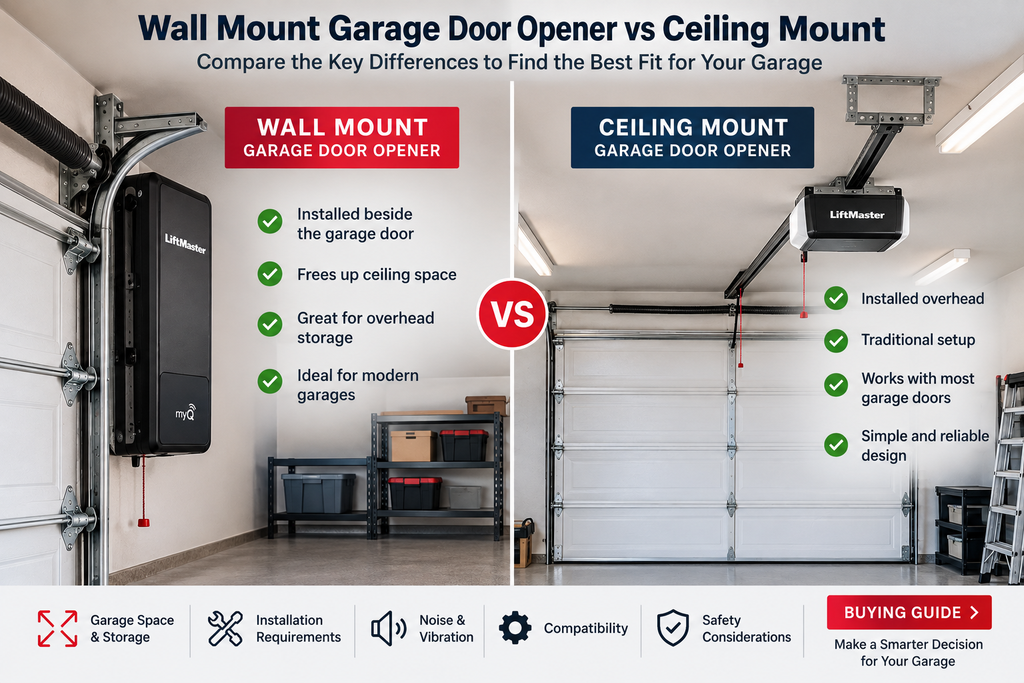
A ceiling-mounted opener is the familiar setup found in many residential garages. The motor unit is installed above the garage door and normally operates the door through a rail and trolley system. A wall-mounted opener, often called a jackshaft opener, is installed beside the garage door and operates the door from the side.
This wall mount garage door opener vs ceiling mount comparison explains the main differences so you can evaluate your garage layout, door configuration, available space, and installation requirements before choosing an opener.

Wall Mount Garage Door Opener vs Ceiling Mount: What Is the Difference?
The biggest difference in a wall mount garage door opener vs ceiling mount comparison is where the opener is installed and how it transfers movement to the garage door.
A wall mount opener is positioned beside the garage door rather than suspended from the ceiling. This arrangement can leave the center of the ceiling open for storage, lighting, vehicles, or other garage uses.
A ceiling mount garage door opener is normally installed above the garage door. A rail extends from the motor toward the door, and a trolley moves along the rail to open and close the door.
Neither arrangement should be selected simply because one looks more convenient. The garage door’s construction, available mounting space, torsion system, electrical arrangement, manufacturer requirements, and installation conditions all need to be considered.
When making a wall mount garage door opener vs ceiling mount decision, start by examining the physical garage rather than choosing an opener based only on appearance or brand familiarity.
The available mounting space should also be measured before making a wall mount garage door opener vs ceiling mount purchase decision. This helps identify potential clearance issues before installation begins.
How Wall Mount Garage Door Openers Work
A wall-mounted opener is mounted on the side of the garage door and works with the door’s torsion-bar system. Instead of using a long overhead rail and trolley, the opener operates the shaft that turns the door’s lifting mechanism.
This design is commonly associated with jackshaft garage door openers. Because the motor is positioned beside the door, there is no conventional opener rail running through the center of the garage ceiling.
According to LiftMaster’s space-saving opener information, wall-mount openers can provide a space-saving arrangement by mounting to the side of the garage door.
The side-mounted arrangement can be useful when overhead clearance or ceiling storage is important. However, the installation must provide the mounting conditions and door configuration required by the particular opener.
The wall mount garage door opener vs ceiling mount choice therefore depends partly on whether moving the opener from the ceiling to the side of the garage provides a practical advantage for the specific installation.
The garage door hardware should also be inspected as part of the wall mount garage door opener vs ceiling mount evaluation because the two configurations use different mounting and operating arrangements.
How Ceiling Mount Garage Door Openers Work
A ceiling mount garage door opener uses an overhead motor and rail system. The motor unit is generally mounted above the garage door, while a trolley travels along the rail and connects to the door.
This configuration has been widely used in residential garages because it works with many common sectional garage door installations. It also places the motor and drive system in a familiar overhead location.
For many garages, the ceiling installation is straightforward when there is adequate overhead clearance and a suitable structure for supporting the opener.
However, the overhead equipment can occupy part of the ceiling area. This may matter when the garage is used for overhead storage, has a low ceiling, or has other equipment installed above the vehicle area.
In a wall mount garage door opener vs ceiling mount comparison, the ceiling-mounted design should therefore be evaluated according to the amount of usable overhead space available in the garage.
The wall mount garage door opener vs ceiling mount decision can also depend on whether the existing garage layout already provides suitable overhead support and clearance.
Wall Mount vs Ceiling Mount Comparison
| Consideration | Wall Mount Opener | Ceiling Mount Opener |
|---|---|---|
| Mounting location | Beside the garage door | Above the garage door |
| Ceiling space | Leaves the center ceiling area more open | Uses overhead space for the opener and rail |
| Drive arrangement | Works through the side-mounted shaft arrangement | Uses an overhead rail and trolley arrangement |
| Mounting requirements | Requires suitable side mounting conditions | Requires suitable overhead support |
| Storage considerations | Can make overhead storage easier to plan | Overhead opener and rail occupy ceiling space |
| Compatibility | Depends on door and shaft configuration | Depends on door, clearance, and opener requirements |
This wall mount garage door opener vs ceiling mount comparison shows why there is no single installation arrangement that automatically fits every garage. The correct choice depends on the door, available space, mounting conditions, and manufacturer’s specifications.
A careful wall mount garage door opener vs ceiling mount comparison should consider the complete installation rather than one feature in isolation.
Garage Space and Storage
Garage space is one of the most important factors in a wall mount garage door opener vs ceiling mount decision.
A wall-mounted opener does not require the traditional overhead rail running from the motor toward the garage door. This can make the center portion of the ceiling easier to use for storage or other equipment.
This arrangement may be useful when a homeowner wants to preserve overhead space for storage, lighting, or other garage equipment.
A ceiling mount system occupies some overhead space, but that does not automatically make it unsuitable. If the garage has plenty of ceiling clearance and no need for overhead storage, the space occupied by the opener may not be a significant concern.
Before choosing either type, measure the garage rather than relying on photographs or general assumptions. Consider the ceiling height, door height, storage systems, lighting, ventilation equipment, and any other objects occupying the ceiling.
For homeowners with limited overhead space, the wall mount garage door opener vs ceiling mount comparison becomes especially useful because the mounting position can change how the remaining garage space is used.
A garage owner should also consider future storage plans when evaluating a wall mount garage door opener vs ceiling mount system, particularly if overhead racks or other ceiling-mounted equipment may be added later.
Installation Requirements
Installation requirements are another major difference when comparing a wall mount garage door opener vs ceiling mount system.
A wall-mounted opener requires a suitable mounting location beside the garage door. The side of the door must provide the structural and mechanical conditions specified by the opener manufacturer.
The torsion shaft and related door hardware also need to be suitable for the particular opener. A wall-mounted system should never be assumed to fit simply because the garage door is a sectional door.
A ceiling-mounted opener requires appropriate overhead support and sufficient clearance for the motor, rail, trolley, and door movement. The installation also needs to account for the position of the garage door when it is fully open.
Manufacturer installation instructions should be checked before purchasing either design. If the installation involves garage door springs, cables, or other high-tension components, professional service may be appropriate.
The wall mount garage door opener vs ceiling mount choice should therefore be made only after the available mounting surfaces and door hardware have been evaluated.
Installation conditions can make a significant difference in the wall mount garage door opener vs ceiling mount decision, so measurements should be completed before ordering an opener.
Noise and Vibration
Noise is another factor homeowners often consider when comparing a wall mount garage door opener vs ceiling mount configuration.
Because a wall-mounted opener is positioned beside the garage door rather than suspended from the ceiling, its operating arrangement can reduce the amount of opener-related vibration transferred through the ceiling structure.
LiftMaster’s quiet-home information discusses wall-mount opener designs in relation to reducing garage-related noise and vibration in the home.
However, the opener itself is not the only source of garage door noise. Rollers, hinges, springs, tracks, bearings, and the door can all contribute to operating sounds.
A properly maintained garage door can therefore make a substantial difference regardless of whether the opener is wall mounted or ceiling mounted.
When evaluating the wall mount garage door opener vs ceiling mount options, consider the complete garage door system rather than assuming the mounting position alone determines operating noise.
Garage Door Compatibility
Compatibility should be checked before making a wall mount garage door opener vs ceiling mount decision.
Wall-mounted systems depend on the garage door’s side-mounted hardware and shaft arrangement. The manufacturer may specify requirements for the torsion system, shaft, door type, mounting surface, or other components.
Ceiling-mounted systems also have compatibility requirements. Door weight, height, construction, travel requirements, available clearance, and the opener’s specifications all need to be considered.
Do not assume that an opener will work with every residential garage door. Check the manufacturer’s compatibility information for the specific door and installation.
If the garage door has unusual construction, modified hardware, limited side clearance, or a non-standard operating arrangement, professional evaluation can help identify the appropriate opener configuration.
The wall mount garage door opener vs ceiling mount comparison should always come after checking these compatibility factors, not before them.
The existing torsion-bar arrangement is another important part of the wall mount garage door opener vs ceiling mount evaluation because a wall-mounted design depends on the door’s side operating configuration.
Maintenance and Access
Maintenance should also be considered when evaluating a wall mount garage door opener vs ceiling mount system.
A wall-mounted opener is installed beside the garage door, which can make the unit accessible from the side of the garage. The exact accessibility depends on the installation location and surrounding equipment.
A ceiling-mounted opener is positioned overhead, so access to the motor unit and rail may require working above the garage door.
Regardless of the design, maintenance should follow the manufacturer’s instructions. The garage door itself should also be inspected for unusual noise, uneven movement, damaged hardware, or other signs that service may be required.
The opener should not be used to compensate for a garage door that is difficult to move manually. Door balance and mechanical condition are separate considerations from the choice of opener.
Safety Considerations
Safety is essential regardless of whether you choose a wall-mounted or ceiling-mounted system.
Garage door openers use safety systems designed to respond to obstructions and help prevent the door from continuing to close under certain conditions. These systems should be installed, tested, and maintained according to the manufacturer’s instructions.
Never bypass or disable safety features simply to make an opener operate differently.
Garage door springs and related lifting components can also contain significant stored energy. Homeowners should avoid adjusting or removing high-tension spring components unless they have the appropriate training and equipment.
The safest approach is to separate opener selection from spring adjustment. Choose an opener based on documented compatibility, and use a qualified garage door professional when the existing door hardware requires specialized service.
Safety should remain part of the wall mount garage door opener vs ceiling mount evaluation instead of being treated as an afterthought.
Which Garage Layout Suits Each Type?
Wall Mount Opener May Suit Garages Where Ceiling Space Matters
A wall-mounted design can be considered when the garage owner wants to keep the central ceiling area more open. This can be particularly relevant where overhead storage, lighting, vehicle clearance, or other ceiling-mounted equipment is important.
The key requirement is that the garage door and side mounting location meet the opener manufacturer’s requirements.
Ceiling Mount Opener May Suit Conventional Overhead Layouts
A ceiling-mounted opener can be practical when the garage already has suitable overhead clearance and support for an opener rail and motor.
If there is no need to preserve the center ceiling area, a conventional overhead configuration may fit naturally into the garage layout.
The choice should therefore be based on the physical garage rather than simply choosing one design because it is more familiar.
Looking at the garage layout first makes the wall mount garage door opener vs ceiling mount decision more practical and helps prevent problems caused by insufficient clearance or unsuitable mounting locations.
Common Buying Mistakes
Choosing Only by Price
The lowest purchase price does not necessarily identify the appropriate opener. Installation requirements, compatibility, available space, safety features, and the garage door itself should also be considered.
Ignoring the Garage Layout
Buying an opener before measuring the garage can create clearance or mounting problems. Measure the ceiling, side spaces, door height, and location of existing equipment first.
Assuming Every Wall Mount Opener Fits
Wall-mounted systems require suitable door and shaft configurations. Always verify compatibility with the manufacturer’s documentation.
Ignoring the Mounting Surface
The opener needs an appropriate structure for mounting. A convenient-looking location is not necessarily a suitable structural mounting point.
Focusing Only on Smart Features
Wi-Fi connectivity, lighting, battery backup, and other features can be useful, but they should not take priority over basic compatibility and installation requirements.
Attempting Spring Repairs During Installation
Garage door springs can be dangerous because they store substantial mechanical energy. Opener installation should not be treated as an opportunity to make unqualified adjustments to spring systems.
Wall Mount vs Ceiling Mount Comparison Checklist
Use the following checklist before deciding between the two configurations:
- Measure the garage ceiling height.
- Measure the available wall space beside the garage door.
- Check the garage door type and construction.
- Identify the existing torsion-bar arrangement.
- Check available overhead clearance.
- Identify existing ceiling storage or equipment.
- Check the manufacturer’s compatibility requirements.
- Review the required mounting structure.
- Consider noise and vibration requirements.
- Review available safety and convenience features.
- Determine whether professional installation is appropriate.
Using this checklist makes the wall mount garage door opener vs ceiling mount decision easier because it focuses on the actual conditions of the garage rather than general assumptions.
Before ordering, use the checklist to confirm that the selected opener meets the garage’s requirements. This is an important step in any wall mount garage door opener vs ceiling mount comparison.
How to Choose Between Wall Mount and Ceiling Mount
The best way to approach a wall mount garage door opener vs ceiling mount decision is to start with the garage rather than the opener.
First, determine whether there is enough ceiling space for a conventional overhead system. If the ceiling is already crowded with storage, lighting, ductwork, or other equipment, a wall-mounted arrangement may deserve closer consideration.
Next, inspect the side of the garage door. A wall-mounted opener requires a suitable mounting location and compatible door hardware. If those requirements cannot be met, a ceiling-mounted system may be more appropriate.
After checking physical compatibility, compare the features that matter to your household. These may include battery backup, lighting, connected controls, automatic closing functions, and the manufacturer’s available safety features.
Finally, review the manufacturer’s installation and compatibility documentation before purchasing. This is especially important when replacing an existing opener or changing from one opener configuration to another.
For a practical wall mount garage door opener vs ceiling mount evaluation, compare the physical requirements first, then consider convenience features and long-term use.
Final Thoughts
The wall mount garage door opener vs ceiling mount comparison ultimately comes down to the garage’s physical layout, door configuration, mounting requirements, and the features you actually need.
A wall-mounted opener places the motor beside the garage door and can preserve more of the central ceiling area. A ceiling-mounted opener uses the familiar overhead motor and rail arrangement and may work well where sufficient overhead clearance and support are available.
Neither design should be selected without checking compatibility. Measure the garage, inspect the existing door hardware, review the manufacturer’s requirements, and consider how the opener will fit into the way the garage is used.
The final wall mount garage door opener vs ceiling mount decision should account for compatibility, space, installation, safety, maintenance, and the way the garage will be used over time.
For additional garage door opener buying information, visit our Garage Door Operator Buying Guides.
FAQ
Is a wall mount garage door opener better than a ceiling mount opener?
The appropriate choice depends on the garage. A wall-mounted system can preserve central ceiling space, while a ceiling-mounted system may suit garages with adequate overhead clearance and support. Compatibility and installation requirements should be checked before choosing either design.
What is the main difference between a wall mount and ceiling mount garage door opener?
A wall mount opener is installed beside the garage door and operates through the side-mounted shaft arrangement. A ceiling mount opener is installed above the garage door and normally uses an overhead rail and trolley.
Does a wall mount garage door opener save ceiling space?
Yes. A wall-mounted design can leave the central ceiling area more open because it does not require the conventional overhead opener rail and motor arrangement.
Does a ceiling mount garage door opener take up ceiling space?
Yes. A conventional ceiling-mounted system uses space above the garage door for the motor and rail. The amount of space required depends on the opener and garage configuration.
Are wall mount garage door openers quieter?
A wall-mounted configuration can reduce opener-related vibration transferred through the ceiling structure. However, total garage door noise also depends on the door, rollers, hinges, springs, tracks, and maintenance condition.
Can every garage door use a wall mount garage door opener?
No. Wall-mounted openers have specific compatibility and installation requirements. The garage door’s shaft arrangement, mounting location, hardware, and other conditions should be checked against the manufacturer’s requirements.
Does a wall mount garage door opener need a torsion bar?
Wall-mounted jackshaft-style openers generally operate through the garage door’s torsion shaft arrangement. The exact requirements depend on the opener model, so the manufacturer’s compatibility information should be checked.
Which opener is better for limited ceiling space?
A wall-mounted configuration can be considered when preserving ceiling space is important because the motor is installed beside the garage door rather than using a conventional overhead rail system.
Can I install a wall mount garage door opener myself?
Installation depends on the specific opener and garage door. Follow the manufacturer’s installation instructions and seek professional assistance when the installation involves structural mounting, high-tension springs, or unfamiliar garage door hardware.
What should I check before buying a wall mount or ceiling mount opener?
Check the garage door type, door dimensions, available ceiling and wall space, torsion-bar arrangement, mounting structure, electrical requirements, manufacturer compatibility information, and the features required for your installation.
Does the choice of opener affect garage storage?
It can. A wall-mounted opener can leave more of the central ceiling area available for storage or other equipment, while a conventional ceiling-mounted opener occupies overhead space with the motor and rail.
What should I compare first when choosing between wall mount and ceiling mount?
Start with compatibility, mounting space, garage door configuration, and installation requirements. Once those factors are confirmed, compare features such as lighting, connected controls, battery backup, and other functions that are relevant to the installation.

Pingback: Garage Opener Replacement: 7 Easy Steps for a Better Upgrade