Uncategorized
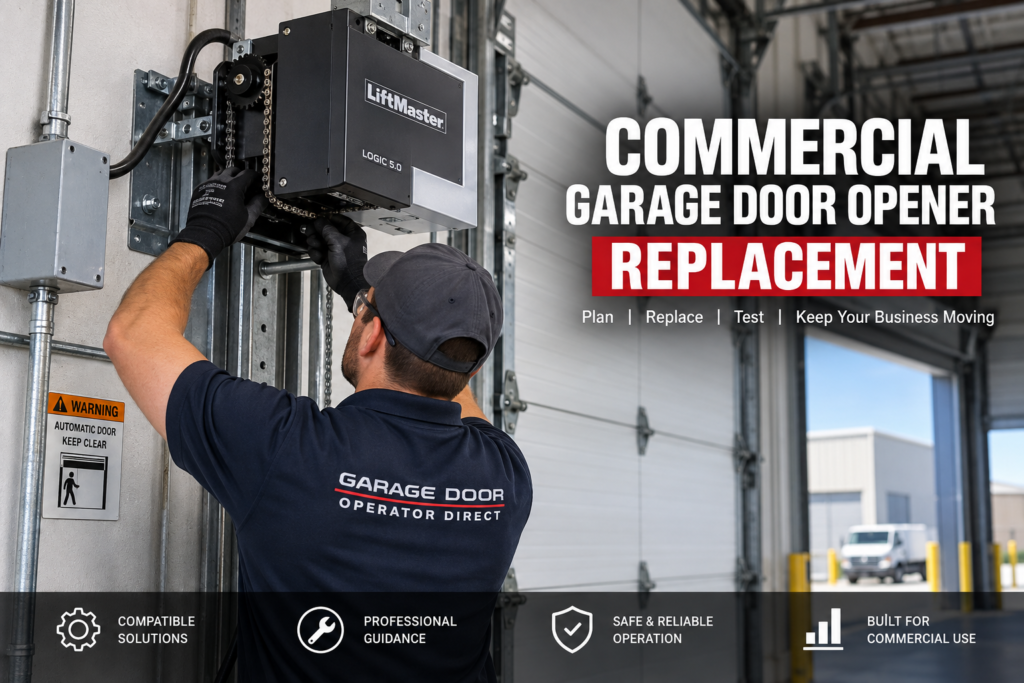
Commercial Garage Door Opener Replacement
Sep
Commercial Garage Door Opener Replacement
Commercial garage door opener replacement requires more than removing an old operator and installing a new one. The replacement must match the commercial door, lifting configuration, electrical service, mounting conditions, operating requirements, controls, and required safety equipment.
Whether an existing operator has become unreliable, suffered significant damage, reached the end of its useful service, or no longer suits the application, careful planning can make commercial garage door opener replacement more efficient and help avoid compatibility problems.
This guide explains how to evaluate an existing commercial operator, determine whether replacement is appropriate, choose compatible equipment, prepare the door, plan the installation, verify electrical and safety requirements, and test the completed system.
10 Proven Tips for Commercial Garage Door Opener Replacement
The following tips cover the most important stages of commercial garage door opener replacement, from inspecting the existing system to selecting and testing the replacement operator.
1. Inspect the Existing Commercial Door
Before beginning commercial garage door opener replacement, inspect the door itself. A replacement operator should not be expected to correct mechanical problems with the door.
Check the tracks, rollers, springs, cables, hinges, shafts, brackets, bearings, and other components used by the door system. The door should travel smoothly and consistently before a replacement operator is installed.
If the door binds, drags, sticks, or has damaged components, address those issues before proceeding. Installing a new operator on a mechanically defective door can create additional operating problems.
2. Identify the Existing Operator
Record the manufacturer, model, motor or horsepower information where applicable, electrical configuration, mounting arrangement, control system, and other available information from the existing operator.
Identifying the existing equipment can make commercial garage door opener replacement easier because it provides a starting point for determining the application’s requirements.
However, the old operator should not automatically determine the replacement. The new equipment still needs to be verified against the actual door, operating conditions, and installation environment.
3. Determine Why the Operator Is Being Replaced
Understanding the reason for replacement helps determine what the new system needs to accomplish.
An operator may be replaced because of repeated failures, damaged components, age, changes to the door, changes in usage, difficulty obtaining compatible repair parts, or a change in the required operator configuration.
During commercial garage door opener replacement, identify the original problem instead of simply installing another operator with identical characteristics.
If the existing system is failing because of a mechanical door problem, replacing the operator alone may not address the underlying issue.
4. Verify Door Compatibility
Compatibility is one of the most important considerations when planning commercial garage door opener replacement.
Consider the door type, dimensions, approximate weight, lift configuration, operating frequency, available mounting space, electrical requirements, and control requirements.
Our Commercial Garage Door Opener category provides access to commercial operator options for compatible applications.
For manufacturer guidance on selecting commercial operators, review the LiftMaster Commercial Door Operator Buyer’s Guide.
5. Check the Mounting Configuration
The replacement operator needs to fit the available mounting arrangement or be installed using the appropriate new mounting hardware.
Check available headroom, side room, shaft position, structural supports, and clearance around the door.
Do not assume that a replacement operator will use exactly the same mounting points as the previous unit. Verify the manufacturer’s mounting requirements before installation.
A properly planned mounting arrangement can also make future inspection and servicing easier.
6. Verify Electrical Requirements
Electrical requirements should be checked before commercial garage door opener replacement. Commercial operators can have different voltage, phase, amperage, and wiring requirements.
Compare the replacement operator’s electrical requirements with the available electrical service before installation.
Electrical work should be completed by a qualified professional where required by local regulations. Disconnect power before servicing electrical components and follow applicable electrical safety requirements.
Never assume that a replacement operator uses the same electrical configuration as the old unit simply because the two operators perform a similar function.
7. Select a Compatible Replacement Operator
Once the door and installation requirements have been established, select a compatible replacement operator.
For example, the Genie GCL-GH can be evaluated for compatible commercial door applications.
The LiftMaster GSD is another commercial operator option for compatible applications.
Other options include the Manaras Opera MGH and Manaras Opera Rapido RSH.
Always verify the specific operator’s current documentation and compatibility before purchasing or installing equipment.
8. Plan the Safety Equipment
Safety equipment should be considered an essential part of commercial garage door opener replacement.
Depending on the operator and door configuration, the system may require photoelectric sensors, monitored safety devices, sensing edges, reversing systems, or other protective equipment.
Install and test safety equipment according to the requirements of the replacement operator and door system.
Never bypass a required safety device simply because the previous installation did not use one.
9. Review Controls and Accessories
A replacement operator may require different wall controls, stations, receivers, remotes, access-control equipment, or other control components.
Do not assume that every control from the old operator can automatically be transferred to the replacement.
During commercial garage door opener replacement, verify the compatibility of existing controls before reconnecting them.
If the control system is being changed, document the new configuration so future servicing is easier.
10. Adjust and Test the Replacement System
After installation, the replacement operator must be adjusted and tested according to the manufacturer’s requirements.
Set the appropriate open and close limits, test the door through complete cycles, inspect the movement of the door, and verify applicable safety functions.
A successful commercial garage door opener replacement should leave the complete door system operating consistently and safely.
Any abnormal noise, vibration, hesitation, binding, or unexpected stopping should be investigated before the system is placed into normal service.
When Should a Commercial Garage Door Opener Be Replaced?
There is no single replacement interval that applies to every commercial operator. Operating frequency, environment, maintenance, door condition, operator design, and application all affect service life.
Replacement may become a consideration when an operator experiences repeated failures, when compatible repair components are difficult to obtain, when the equipment no longer meets the application’s requirements, or when the existing system has sustained significant damage.
However, a malfunction does not automatically mean that the entire operator needs to be replaced. A qualified inspection can help determine whether repair or commercial garage door opener replacement is appropriate.
Repair or Replacement?
One of the most important decisions is whether to repair the existing operator or replace it.
If a relatively minor component has failed and the operator remains suitable for the application, repair may be possible.
If the operator has extensive damage, repeated failures, obsolete components, or an unsuitable configuration, replacement may be considered.
Our Commercial Door Operator Repair guide covers repair considerations in greater detail.
The important point is to evaluate the entire door and operator system rather than automatically replacing equipment based on one failure.
Replacement Planning Checklist
| Check | What to Verify |
|---|---|
| Existing door | Confirm the door is mechanically suitable for continued operation. |
| Existing operator | Record manufacturer, model, configuration, and electrical information. |
| Reason for replacement | Determine whether the problem is operator-related, door-related, or application-related. |
| Door compatibility | Verify the replacement operator matches the door and application. |
| Mounting | Check structural support, clearance, and mounting requirements. |
| Electrical | Verify voltage, phase, wiring, and electrical service. |
| Safety devices | Install and test required safety equipment. |
| Controls | Verify wall stations, controls, receivers, and access systems. |
| Final testing | Run complete cycles and verify correct operation. |
Common Commercial Operator Replacement Mistakes
Several mistakes can complicate commercial garage door opener replacement. Avoid choosing a replacement based only on the model of the old operator.
- Failing to inspect the existing door.
- Assuming the old mounting points will fit the new operator.
- Ignoring the door’s weight and lift configuration.
- Failing to verify electrical requirements.
- Reusing incompatible controls.
- Ignoring required safety devices.
- Failing to adjust operating limits.
- Skipping final safety testing.
- Choosing an operator without considering the commercial application.
- Replacing the operator without determining why the previous system failed.
Related Commercial Door Operator Guides
Commercial garage door opener replacement is part of a broader Commercial Door Operators content cluster. These related guides cover installation, repair, replacement, troubleshooting, and documentation.
- Commercial Garage Door Opener Installation — Review operator selection, mounting, safety equipment, adjustment, and testing.
- Commercial Door Operator Repair — Learn about commercial operator repair considerations and common problems.
- Commercial Door Opener Installation — Explore additional information about commercial door opener installation.
- Commercial Door Operator Replacement — Review replacement considerations for commercial door operators.
- LiftMaster Commercial Garage Door Opener Troubleshooting — Explore troubleshooting considerations for compatible LiftMaster commercial systems.
- LiftMaster Commercial Garage Door Opener Manual — Find information about applicable LiftMaster commercial operator documentation.
Maintenance After Replacement
Completing commercial garage door opener replacement does not eliminate the need for regular maintenance. The replacement operator and door should be inspected periodically according to the manufacturer’s recommendations and the demands of the application.
Pay attention to unusual noise, vibration, inconsistent stopping, slow movement, damaged wiring, loose mounting hardware, or changes in the way the door travels.
Regular inspection can help identify developing mechanical or electrical problems before they become larger system issues.
Manufacturer Documentation and Installation Resources
Manufacturer documentation should be used for model-specific installation, adjustment, wiring, and operating requirements.
For LiftMaster commercial operator selection information, review the LiftMaster Commercial Door Operator Buyer’s Guide.
For Genie commercial operator manuals, specifications, and technical documentation, review the Genie Commercial Documents.
You can also review LiftMaster Commercial Garage Door Openers for manufacturer information about commercial operator applications.
For Genie commercial operator information, see Genie Commercial Garage Door Openers.
Professional Commercial Operator Replacement
Commercial door operators can involve heavy doors, powerful motors, springs, electrical systems, and safety equipment. Professional assistance may be appropriate when the replacement involves complex mechanical work, electrical modifications, unusual door configurations, or safety-system installation.
The manufacturer’s installation documentation should take precedence over general online instructions.
Where local regulations require qualified electrical or commercial-door professionals, those requirements should be followed.
Commercial Garage Door Opener Replacement and Business Continuity
For businesses that rely on an overhead door throughout the day, an operator problem can interfere with normal access and daily operations. Planning the replacement around the actual application can help reduce unnecessary downtime.
Before beginning commercial garage door opener replacement, identify the door’s normal operating schedule, the people who need access, the available service window, and any control or access-system requirements.
It can also be useful to have the replacement equipment, mounting hardware, controls, and required safety components identified before the existing operator is removed.
Final Considerations
A successful commercial garage door opener replacement begins with understanding the existing door and operator rather than simply selecting a replacement motor.
Inspect the door, identify the existing equipment, determine why replacement is necessary, verify compatibility, check the mounting arrangement and electrical requirements, select appropriate equipment, install the required safety devices, and thoroughly test the completed system.
If you are comparing commercial operator options, visit our Commercial Garage Door Opener category.
Frequently Asked Questions
How do I know if I need commercial garage door opener replacement?
Replacement may be considered when an operator has repeated failures, significant damage, obsolete components, or no longer meets the requirements of the commercial door application. A qualified inspection can help determine whether repair or commercial garage door opener replacement is appropriate.
Can I replace a commercial garage door opener with a different brand?
A different manufacturer may be suitable when the replacement operator is compatible with the door, mounting arrangement, electrical service, controls, and application requirements. Brand matching alone does not determine compatibility.
Do I need to replace the garage door when replacing the operator?
Not necessarily. If the existing commercial door is mechanically sound and suitable for the application, the operator may be replaced independently. The door should be inspected before beginning the replacement.
Can I reuse the existing wall controls?
It depends on the replacement operator and the specific control equipment. Verify compatibility before reconnecting existing controls.
What should I check before buying a replacement operator?
Check the door type, dimensions, weight, lift configuration, operating frequency, electrical requirements, mounting conditions, control requirements, and applicable safety equipment.
Should a commercial garage door opener replacement be professionally installed?
Professional installation may be appropriate for commercial systems involving heavy doors, electrical work, complex mounting arrangements, or safety equipment. Follow the manufacturer’s installation requirements and applicable local regulations.
How can I avoid compatibility problems when replacing a commercial operator?
Document the existing door and operator, verify the door’s mechanical condition, compare the replacement operator’s specifications with the application, and confirm mounting, electrical, control, and safety requirements before installation.
What should I do before removing the old operator?
Document the existing configuration, identify the door and operator specifications, verify the replacement equipment, and plan the required mounting, electrical, control, and safety work before removing the existing unit.

Pingback: Commercial Door Operator Repair | 10 Proven Fixes
Pingback: Commercial Door Opener Installation | 10 Proven Steps
Pingback: LiftMaster Commercial Garage Door Opener Troubleshooting | 10 Proven
Pingback: LiftMaster Commercial Garage Door Opener Manual | 10 proven