Uncategorized
COMMERCIAL DOOR OPENER INSTALLATION
Sep
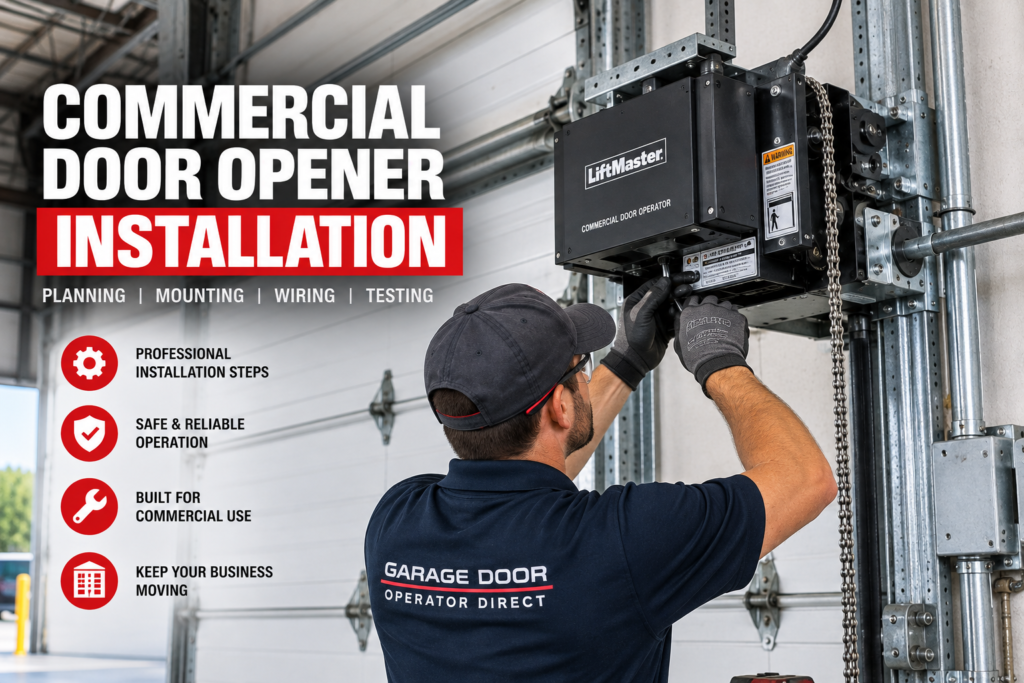
Commercial Door Opener Installation
Commercial door opener installation requires more than mounting an operator and connecting a motor. The complete system must be suitable for the commercial door, lifting configuration, operating frequency, mounting conditions, electrical service, controls, and required safety equipment.
Before beginning commercial door opener installation, inspect the existing door and determine exactly what the application requires. A properly selected and installed operator should work with the door rather than compensate for mechanical problems, incorrect mounting, or unsuitable equipment.
This guide explains the major stages of commercial door opener installation, from evaluating the door and choosing an operator to mounting, electrical connections, safety equipment, adjustment, testing, and ongoing maintenance.
What Is Commercial Door Opener Installation?
Commercial door opener installation is the process of installing a powered operator and the components required to control a commercial overhead door. Depending on the system, the installation can involve the operator, mounting hardware, drive components, electrical connections, wall controls, access-control equipment, safety devices, and travel adjustments.
The exact installation procedure varies according to the operator model and door configuration. A sectional commercial door may require a different operator arrangement from another overhead door application.
For that reason, commercial door opener installation should always be planned around the specific door and operator rather than a generic installation method.
Planning Commercial Door Opener Installation
Successful commercial door opener installation starts before the first mounting bracket is installed. The door, operator, electrical service, controls, safety equipment, and available mounting space should all be evaluated before work begins.
Start by identifying the existing door and operator, reviewing the manufacturer’s documentation, and determining the requirements of the application. This helps reduce compatibility problems and makes the installation process more organized.
10 Key Steps for Commercial Door Opener Installation
1. Inspect the Door Before Installation
Before starting commercial door opener installation, inspect the existing commercial door and its accessible mechanical components.
Check the tracks, rollers, hinges, brackets, shafts, cables, springs, bearings, and other relevant hardware for obvious damage or mechanical restrictions.
The door should be capable of moving correctly before the operator is installed. An opener is designed to operate the door; it should not be expected to correct serious mechanical problems with the door itself.
If the door binds, drags, sticks, or moves unevenly, address the underlying problem before continuing with the commercial door opener installation.
High-tension springs, cables, and other hazardous components should only be serviced by appropriately trained professionals.
2. Confirm the Door Type and Configuration
The door configuration directly affects commercial door opener installation. Identify the type of commercial overhead door, its dimensions, approximate weight, lift configuration, and available space around the installation area.
Determine whether the application involves a sectional door, rolling door, or another compatible commercial overhead door configuration. The selected operator must be designed for the specific application.
Do not assume that an operator suitable for one commercial door configuration will automatically be appropriate for another.
3. Evaluate the Commercial Application
Operating frequency and duty requirements are important considerations during commercial door opener installation.
A warehouse door used repeatedly throughout the day can place different demands on an operator than a door that operates only occasionally. Consider the expected cycles, environment, door size, approximate weight, and overall operating conditions.
The operator should be selected according to the actual application rather than simply choosing a model that appears physically similar to the existing unit.
For compatible commercial operator options, visit the Commercial Garage Door Opener category.
4. Select a Compatible Commercial Operator
Choosing the correct operator is one of the most important stages of commercial door opener installation.
Consider the door type, lifting configuration, approximate door weight, operating frequency, mounting requirements, electrical service, controls, and applicable safety equipment before selecting the operator.
Commercial operator options available for evaluation include the Genie GCL-GH, LiftMaster GSD, Manaras Opera MGH, and Manaras Opera Rapido RSH.
Always verify the individual operator’s specifications and compatibility before purchasing or installing equipment.
5. Prepare the Mounting Location
Proper mounting is essential for reliable commercial door opener installation.
Check the available headroom, side room, shaft position, structural support, operator clearance, and access required for future inspection and service.
The operator must be supported according to the manufacturer’s requirements. Do not assume that the mounting points used by an existing operator will automatically work for a replacement operator.
Incorrect mounting can contribute to excessive vibration, movement, mechanical stress, or alignment problems.
6. Verify Electrical Requirements
Electrical requirements should be confirmed before completing commercial door opener installation.
Commercial operators can have different voltage, phase, amperage, wiring, and electrical-service requirements. Compare the operator’s requirements with the available electrical service before making connections.
Electrical work should be completed by a qualified professional where required by local regulations. Disconnect power before servicing electrical components and follow all applicable electrical safety requirements.
Never assume that wiring from an old operator can simply be transferred to a new unit without checking the manufacturer’s requirements.
7. Install the Operator and Drive System
During commercial door opener installation, install the operator and drive components according to the manufacturer’s instructions.
Depending on the operator design, the drive system can include chains, belts, gears, sprockets, shafts, couplings, brackets, or other components.
Make sure the operator is securely supported and that the drive components are installed in the correct configuration. Follow the manufacturer’s instructions for alignment, mounting, and adjustment.
Do not improvise a mounting or drive arrangement that is not supported by the operator documentation.
8. Connect Controls and Safety Equipment
Controls and safety equipment are essential parts of commercial door opener installation.
Depending on the system, controls may include wall stations, push buttons, key switches, receivers, remote controls, or access-control equipment.
Safety equipment may include photoelectric sensors, monitored safety devices, sensing edges, or other protective components required by the operator and door system.
Install and connect these components according to the manufacturer’s instructions. Never bypass a required safety device simply to make the operator operate.
9. Adjust Travel and Operating Settings
After commercial door opener installation, the operator may require adjustment of the open and close travel limits or other operating settings.
The correct adjustment procedure depends on the specific operator model. Use the manufacturer’s instructions for the exact operator rather than applying a generic adjustment procedure.
Incorrect settings can cause the door to stop too early, travel beyond the intended position, or behave differently from the manufacturer’s specified operating sequence.
10. Test the Complete Installation
The final stage of commercial door opener installation is complete system testing.
Operate the door through its normal cycle and observe the opening and closing movement. Check the controls, stopping positions, operator response, drive system, and applicable safety equipment.
Listen for unusual noise and watch for vibration, hesitation, slipping, binding, or inconsistent movement.
Test applicable safety functions according to the manufacturer’s instructions before returning the door to normal commercial service.
Commercial Door Opener Installation Checklist
| Installation Area | What to Verify |
|---|---|
| Door condition | Door moves correctly without obvious mechanical restrictions. |
| Door configuration | Operator is suitable for the door type and lift configuration. |
| Application | Operator matches door requirements and expected operating frequency. |
| Operator selection | Model is compatible with the actual commercial application. |
| Mounting | Structural support, clearance, and mounting requirements are satisfied. |
| Electrical | Voltage, phase, wiring, and electrical service are compatible. |
| Drive system | Chains, belts, gears, sprockets, shafts, and connections are correctly installed. |
| Controls | Wall stations and other control equipment are correctly connected. |
| Safety equipment | Required safety equipment is installed and tested. |
| Travel settings | Open and close positions are correctly adjusted. |
| Final testing | Complete operating cycles and applicable safety functions are verified. |
Commercial Door Opener Installation: Final Inspection
A final inspection confirms that the commercial door opener installation has been completed correctly.
Check the operator mounting, drive components, electrical connections, controls, safety devices, travel settings, and overall door movement.
If the door produces unusual noise, vibration, hesitation, slipping, or inconsistent movement, stop and investigate the cause before returning the system to normal commercial service.
Common Commercial Door Opener Installation Mistakes
Choosing an Operator Without Inspecting the Door
Selecting an operator before evaluating the door can create compatibility problems. Door condition, configuration, approximate weight, operating frequency, and available mounting space all affect operator selection.
Assuming Existing Mounting Points Will Work
Different commercial operators can have different mounting requirements. Always compare the new operator’s instructions with the available structural support.
Ignoring Electrical Requirements
Commercial operators may require different electrical configurations. Verify voltage, phase, amperage, and wiring requirements before beginning electrical connections.
Reusing Incompatible Controls
Wall stations, receivers, remote controls, and access-control equipment are not automatically compatible with every operator.
Verify control compatibility before reconnecting existing equipment during commercial door opener installation.
Skipping Safety Testing
A commercial door should not be returned to normal service without testing the applicable safety equipment and operating functions.
Never bypass a required safety device simply to complete the installation.
Failing to Test the Door After Adjustment
Travel adjustments should always be followed by complete operating-cycle testing. Confirm that the door reaches the intended positions and that applicable safety functions operate correctly.
Commercial Door Opener Installation vs. Repair
Not every commercial operator problem requires a new installation. If the existing operator remains suitable for the application and has a repairable fault, repair may be possible.
Our Commercial Door Operator Repair guide covers common diagnostic areas including power, controls, safety devices, drive components, limits, motors, and electronic controls.
Replacement or new commercial door opener installation may be considered when an operator has extensive damage, repeated failures, obsolete components, or no longer meets the requirements of the application.
Commercial Door Opener Installation and Replacement
When an existing operator needs to be replaced, the replacement process should begin with an inspection of the current door and application.
Our Commercial Garage Door Opener Replacement guide covers compatibility, mounting, electrical requirements, controls, safety equipment, and final testing.
Do not select a replacement operator based only on the model of the old unit. The new operator must be verified against the actual door and operating requirements.
Maintenance After Commercial Door Opener Installation
Completing commercial door opener installation does not eliminate the need for regular maintenance.
Inspect the operator and door system periodically according to the manufacturer’s recommendations and the demands of the application.
Pay attention to unusual noise, vibration, slow movement, inconsistent stopping, damaged wiring, loose mounting hardware, or changes in the way the door travels.
Maintenance records can also help identify recurring problems and determine whether additional service is required.
Manufacturer Resources for Installation
Manufacturer documentation should take precedence over generic online installation instructions when working with a specific commercial operator.
For commercial operator selection information, review the LiftMaster Commercial Door Operators Buyer’s Guide.
For information about commercial operator systems and applications, see LiftMaster Commercial Door Operators.
For Genie commercial operator manuals, technical documents, and other manufacturer resources, visit the Genie Commercial Documents library.
Related Commercial Door Operator Guides
Commercial door opener installation is part of a broader commercial operator information cluster. Continue with these related guides:
- Commercial Garage Door Opener Installation — Review commercial operator installation planning, mounting, safety equipment, adjustment, and testing.
- Commercial Garage Door Opener Replacement — Learn about replacement planning, compatibility, installation, and testing.
- Commercial Door Operator Repair — Learn about common commercial operator problems and repair considerations.
- Commercial Door Operator Replacement — Review replacement considerations for commercial door operators.
- LiftMaster Commercial Garage Door Opener Troubleshooting — Explore troubleshooting considerations for compatible LiftMaster commercial systems.
- LiftMaster Commercial Garage Door Opener Manual — Review information about applicable LiftMaster commercial operator documentation.
When to Use a Qualified Professional
Commercial overhead door installation can involve heavy doors, electrical systems, high-tension springs, structural mounting, powerful motors, and safety equipment.
Professional assistance may be appropriate when commercial door opener installation requires electrical modifications, structural work, high-tension component service, complex door adjustments, or safety-system installation.
Follow the manufacturer’s installation documentation and applicable local requirements for the exact commercial operator and door system.
Frequently Asked Questions
What is commercial door opener installation?
Commercial door opener installation is the process of installing a powered operator and its required components on a commercial overhead door. It can include mounting, drive components, electrical connections, controls, safety equipment, adjustments, and final testing.
How long does commercial door opener installation take?
The time required for commercial door opener installation depends on the operator, door configuration, mounting arrangement, electrical requirements, controls, safety equipment, and condition of the existing door. More complex commercial systems can require additional planning and installation work.
What should I check before commercial door opener installation?
Before commercial door opener installation, check the door condition, door type, dimensions, approximate weight, lift configuration, operating frequency, mounting space, electrical service, controls, and required safety equipment.
Can I install a commercial door opener myself?
Installation requirements vary by operator and application. Commercial systems can involve electrical work, heavy doors, structural mounting, and safety equipment, so qualified professional installation may be appropriate for complex or hazardous work.
How do I choose a commercial door opener?
Consider the door type, dimensions, approximate weight, lift configuration, operating frequency, duty requirements, mounting conditions, electrical service, controls, and safety requirements. Verify the operator against the manufacturer’s specifications.
Does the existing commercial door need to be replaced?
Not necessarily. If the existing door is mechanically sound and suitable for the application, an operator can potentially be installed without replacing the complete door.
Can I reuse the existing controls?
It depends on the operator and control equipment. Verify compatibility before transferring wall stations, receivers, remote controls, or access-control components.
Why is mounting important?
The operator must be properly supported and aligned with the door and drive system. Incorrect mounting can contribute to vibration, mechanical stress, noise, or improper operation.
Should safety devices be installed?
Required safety equipment should be installed and tested according to the operator manufacturer’s instructions and applicable requirements for the door system. Required safety devices should never be bypassed.
What should be tested after installation?
Test the complete door cycle, controls, opening and closing positions, operator response, drive system, and applicable safety functions. Look for unusual noise, vibration, hesitation, or inconsistent movement.
Final Considerations
A successful commercial door opener installation begins with understanding the existing door and application rather than simply selecting an operator that appears to fit.
Inspect the door, identify the lift configuration, establish the operating requirements, select a compatible operator, plan the mounting arrangement, verify electrical requirements, install the drive components, connect controls and safety devices, adjust the system, and perform complete final testing.
For commercial operator options, visit our Commercial Garage Door Opener category.
Proper planning, compatible equipment, correct installation practices, manufacturer documentation, and complete testing can help support reliable commercial overhead door operation.

Pingback: Commercial Door Operator Replacement | Replacement Guide