Uncategorized
Roll Up Door Parts Diagram

Sep
Roll Up Door Parts Diagram: 11 Essential Components Explained
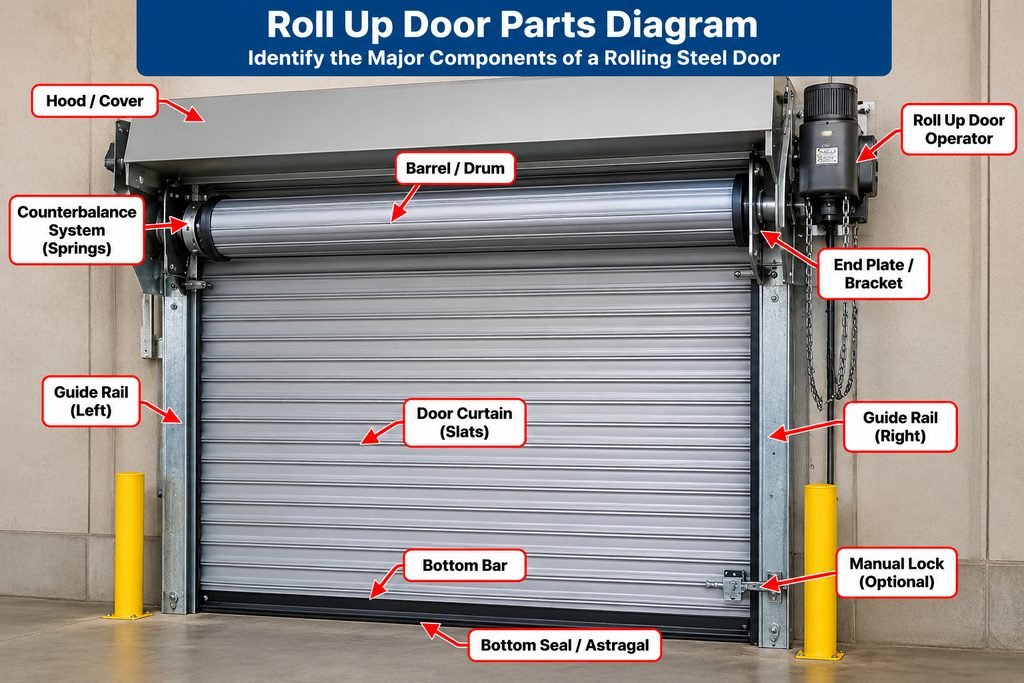
A Roll Up Door Parts Diagram makes it much easier to understand how a rolling door is assembled and how its major components work together. Instead of looking at the entire door as one complicated system, a diagram allows you to identify individual parts such as the curtain, guides, barrel, bottom bar, counterbalance system, hood, and operator.
When a rolling door develops a problem, knowing the names and locations of its components can make inspection and communication much easier. A building owner, maintenance professional, installer, or buyer can use a Roll Up Door Parts Diagram to identify the area that needs attention before looking for a replacement component or service.
The exact construction varies between rolling doors. Commercial rolling service doors, rolling sheet doors, fire doors, counter doors, and other coiling systems can use different components and configurations. DASMA’s rolling-door terminology resources are useful for understanding the industry’s terminology and should be used alongside the manufacturer’s instructions for a specific door.

Quick Navigation
- What a Roll Up Door Parts Diagram Shows
- 1. Door Curtain
- 2. Guide Assemblies
- 3. Barrel and Pipe Assembly
- 4. Counterbalance System
- 5. Bottom Bar
- 6. Hood or Cover
- 7. Door Operator
- 8. Chain Hoist Components
- 9. Weatherseal Components
- 10. Safety Components
- 11. Mounting and Structural Components
- Parts Identification Table
- How to Identify a Replacement Part
- Related Roll Up Garage Door Operators
- Related Rolling Door Articles
- Frequently Asked Questions
What Does a Roll Up Door Parts Diagram Show?
A Roll Up Door Parts Diagram is essentially a visual map of a rolling door assembly. It can show where individual components are positioned and how they relate to the curtain and surrounding opening.
The main curtain travels vertically and then coils around a barrel or related assembly above the opening. Guide assemblies control the movement of the curtain along the sides, while the bottom bar forms the lower edge. Depending on the door design, a counterbalance mechanism, chain hoist, electric operator, hood, sensing device, or other hardware may also be present.
DASMA defines a rolling door as a coiling door typically used in commercial or industrial applications. Its terminology document also distinguishes different types of rolling doors and identifies terminology used for their components.
That is why a Roll Up Door Parts Diagram should be treated as an identification tool rather than a universal blueprint. Different manufacturers can use different designs.
1. Door Curtain
The curtain is the portion of the rolling door that moves up and down to close or open the doorway. Depending on the door, the curtain may consist of interconnected steel slats, sheet material, or another configuration.
On a Roll Up Door Parts Diagram, the curtain is normally one of the largest and easiest components to identify because it spans the width of the opening.
Why the Curtain Matters
The curtain provides the primary physical barrier across the opening. Its construction affects the door’s appearance, security characteristics, operating requirements, and overall configuration.
Damage to individual slats or sections can affect how the curtain travels through the guides and coils above the opening.
For fire-rated rolling doors, component replacement can have additional requirements. DASMA notes that repairs to rolling steel fire doors must follow specific procedures and use appropriate original-manufacturer components where required.
2. Guide Assemblies
The vertical guide assemblies are positioned along the sides of the opening. They guide the curtain as it moves upward and downward.
On a Roll Up Door Parts Diagram, the guides are generally shown on the left and right sides of the curtain.
Guide construction can vary considerably depending on the door type, mounting arrangement, wind requirements, and manufacturer.
Guide Problems to Watch For
- Physical damage to the guide.
- Loose mounting components.
- Obstructions inside the guide.
- Damaged weatherseal.
- Improper curtain alignment.
- Excessive wear.
If the curtain does not travel correctly, the guides should be considered as part of the inspection rather than immediately assuming the operator is responsible.
3. Barrel and Pipe Assembly
The barrel is positioned above the doorway and provides the structure around which the curtain coils when the door opens.
A Roll Up Door Parts Diagram commonly places the barrel above the curtain and between the supporting brackets or end structures.
The barrel assembly can include several components. Depending on the door design, these may include a pipe, shaft, end plates, drive components, and counterbalance-related components.
Why the Barrel Is Important
The barrel supports the coiling action of the curtain. Its dimensions and configuration are related to the door’s design and operating characteristics.
Because the barrel is connected to the curtain and potentially to a counterbalance system or operator, repairs should be approached carefully.
4. Counterbalance System
Many rolling doors use a counterbalance system to help offset the weight of the curtain. The exact arrangement varies according to the door’s size, construction, and operating method.
When studying a Roll Up Door Parts Diagram, the counterbalance components may appear inside or around the barrel assembly.
The counterbalance system can involve springs, shafts, drums, or other components depending on the specific design.
These parts can store significant energy. A person should not disassemble or adjust a counterbalance system without the appropriate training and manufacturer-specific instructions.
DASMA provides technical information on rolling-door counterbalancing, including TDS #272 in its rolling-door technical data sheet library.
5. Bottom Bar
The bottom bar forms the lower portion of the curtain and provides rigidity at the bottom edge.
On a Roll Up Door Parts Diagram, it is usually shown horizontally along the bottom of the closed curtain.
The bottom bar can also interact with weatherseals and, on powered systems, may accommodate sensing-edge components.
Bottom Bar Inspection
- Look for bending or physical damage.
- Check the condition of the sealing material.
- Inspect attachment points.
- Look for alignment problems.
- Check whether the bar contacts the intended surface correctly.
A damaged bottom bar can affect both the physical operation of the door and the way it closes against the opening.
6. Hood or Cover
Some rolling door installations include a hood or cover surrounding the barrel and upper curtain area. The hood can protect components from environmental exposure and provide a finished appearance.
Its location is usually easy to recognize on a Roll Up Door Parts Diagram because it appears above the opening and around the coiled curtain.
Not every rolling door uses the same hood configuration. Some installations may have different covers, exposed barrel arrangements, or other architectural treatments.
When replacing a hood or cover, the dimensions and mounting arrangement should be checked against the specific door.
7. Door Operator
An electric operator provides powered movement for applicable rolling doors. The operator may be mounted in different positions depending on the door design and available space.
DASMA notes that rolling doors can be operated manually, by chain hoist, crank, or electric motor operator. Operators can also be mounted in different positions depending on the application.
On a Roll Up Door Parts Diagram, the operator may appear beside the barrel, above the opening, or in another manufacturer-specified position.
Operator Selection Matters
An operator should not be selected solely because it physically appears capable of moving the door. The door’s weight, size, cycle requirements, mounting arrangement, control system, and manufacturer specifications should be considered.
For this reason, the operator section of a Roll Up Door Parts Diagram is particularly useful when explaining how the door’s mechanical components connect with its powered operating system.
8. Chain Hoist Components
Some rolling doors use a chain hoist rather than an electric motor for manual operation. A chain hoist allows the operator to raise or lower the door using a hand chain.
A Roll Up Door Parts Diagram can help distinguish the chain hoist from the curtain, barrel, and guide assemblies.
Typical components can include a hand chain, chain wheel, gearbox or hoist mechanism, drive components, and associated mounting hardware.
Chain-operated systems have their own maintenance requirements, and the manufacturer’s instructions should be followed when adjustment or repair is required.
9. Weatherseal Components
Weatherseal components help reduce unwanted openings around portions of the rolling door assembly.
A Roll Up Door Parts Diagram may identify sealing components around the guides, header, and bottom edge.
The exact configuration depends on the door. Some systems may use guide weatherseal, bottom astragals, brushes, vinyl, rubber, or other materials.
The correct replacement should be selected according to the door manufacturer’s specifications rather than simply choosing the thickest or widest material available.
10. Safety Components
Powered rolling doors can include safety components designed to help detect obstructions or control operation.
One example is a sensing edge. DASMA’s terminology defines a sensing edge as a device added to the underside of the bottom bar of a power-operated rolling door that can stop or reverse the curtain when contact with an obstruction occurs during powered closing.
The specific safety arrangement depends on the operator and door system.
When using a Roll Up Door Parts Diagram for troubleshooting, safety components should not be confused with ordinary structural components.
If a safety device is malfunctioning, follow the manufacturer’s troubleshooting and service instructions instead of bypassing the device.
11. Mounting and Structural Components
Rolling doors require structural support around the opening. Mounting components can include brackets, plates, guides, fasteners, jamb connections, and header-related components.
A Roll Up Door Parts Diagram can show these components as part of the larger assembly even though they may not move during normal operation.
The surrounding wall construction is also important. Rolling doors can be mounted to different types of jamb and header conditions, including steel, wood, and masonry, depending on the design.
DASMA’s technical resources include documents dealing with rolling-door jamb construction and installation details.
Roll Up Door Parts Identification Table
| Component | Primary Function | Typical Location |
|---|---|---|
| Curtain | Closes the opening | Across doorway |
| Guide assemblies | Control curtain travel | Both sides |
| Barrel | Supports curtain coiling | Above opening |
| Counterbalance | Offsets curtain weight | Usually near barrel |
| Bottom bar | Provides lower-edge support | Bottom of curtain |
| Hood | Covers upper assembly | Above opening |
| Operator | Provides powered movement | Varies by design |
| Chain hoist | Manual operation | Near drive assembly |
| Weatherseal | Reduces perimeter openings | Guides, header, bottom |
| Sensing edge | Provides obstruction sensing | Bottom bar |
| Mounting hardware | Supports assembly | Jambs and header |
How to Use a Roll Up Door Parts Diagram When Ordering Replacement Parts
A Roll Up Door Parts Diagram is especially useful when you need to identify a replacement component.
Start by recording the door manufacturer’s name and model information if available. Then identify the exact component and compare it with the manufacturer’s parts documentation.
Step 1: Identify the Door
Find the manufacturer’s label, model information, serial number, or other identifying information.
Step 2: Locate the Component
Use the Roll Up Door Parts Diagram to determine whether the component belongs to the curtain, guides, barrel, bottom bar, operator, or another section.
Step 3: Record Dimensions
Measure the relevant component when the manufacturer requires dimensions for identification.
Step 4: Verify Compatibility
Do not assume that two components with similar appearances are interchangeable. Confirm the part number and application.
Step 5: Follow Manufacturer Instructions
Installation and repair procedures can vary. Manufacturer documentation should take priority over a generic diagram.
Roll Up Door Parts Diagram vs. Installation Manual
A diagram and an installation manual serve different purposes. A Roll Up Door Parts Diagram primarily helps identify components and their general relationships.
An installation manual provides the specific instructions needed to assemble, adjust, operate, or service a particular door.
For technical work, use both where available. DASMA specifically states that its Technical Data Sheets are information tools and are not substitutes for individual manufacturers’ instructions.
Related Roll Up Garage Door Operators
After identifying the mechanical components of a rolling door, the next step for an automated installation is selecting a compatible operator. The operator must match the specific door and application.
Browse the Roll Up Garage Door Opener category for available products.
Automatic Technology 86341 ShedMaster
Review the Automatic Technology 86341 ShedMaster and verify the application requirements before ordering.
Automatic Technology 87840 EasyRoller14
The Automatic Technology 87840 EasyRoller14 is another product available within this rolling-door product group.
ATA Hiro Operator
You can also examine the ATA Hiro Operator when evaluating compatible rolling-door automation.
LiftMaster LJ8950W
Another option in the product group is the LiftMaster LJ8950W . Verify the door specifications and manufacturer requirements before installation.
Related Rolling Door Articles
The following articles are part of this rolling-door content cluster. These links are intentionally included so the cluster can be connected as the supporting articles are published.
- How to Install a Roll Up Garage Door
- Rolling Steel Door Installation
- How to Seal a Roll Up Door
- Roll Up Door Chain Hoist
- Roll Up Door Parts
- Commercial Roll Up Door Parts
Explore the Complete Roll Up Garage Door Opener Category
If you are researching the components of a rolling door because you are planning an automated installation, visit the Roll Up Garage Door Opener category to compare the available operator products.
Frequently Asked Questions
What is the main purpose of a Roll Up Door Parts Diagram?
The main purpose is to help identify the individual components of a rolling door and understand their general location within the assembly.
What are the main parts of a roll up door?
Common components include the curtain, guides, barrel, counterbalance system, bottom bar, hood, mounting hardware, weatherseal, and an operating mechanism such as a chain hoist or electric operator.
Where is the barrel located?
The barrel is generally located above the doorway and provides the structure around which the curtain coils as the door opens.
What does the bottom bar do?
The bottom bar provides support and rigidity at the bottom of the curtain. Depending on the design, it can also accommodate sealing or sensing components.
What are the guides on a rolling door?
Guides are the vertical assemblies on either side of the opening that help control the curtain as it moves upward and downward.
Does every roll up door have the same parts?
No. Components vary according to the door type, manufacturer, size, application, operating method, and required performance characteristics.
Can I use a generic diagram to repair my door?
A generic Roll Up Door Parts Diagram can help with identification, but it should not replace the manufacturer’s installation, adjustment, or service instructions.
What should I record before ordering a replacement part?
Record the manufacturer, model, serial information, component name, part number if available, dimensions, and photographs of the existing component.
Are rolling door counterbalance components dangerous?
Counterbalance systems can store significant mechanical energy. Adjustment or disassembly should be handled according to the manufacturer’s instructions and, where appropriate, by a qualified technician.
Where can I find technical information about rolling doors?
The DASMA Technical Data Sheets provide industry technical information covering many rolling-door subjects, including terminology, installation, maintenance, counterbalancing, water infiltration, and component-related topics.
Understanding the Complete Rolling Door Assembly
A Roll Up Door Parts Diagram is most useful when it is treated as a starting point for identification rather than a substitute for model-specific documentation. The curtain, guides, barrel, bottom bar, counterbalance system, hood, operator, chain hoist, weatherseal, safety components, and mounting hardware each have their own role.
Understanding those relationships makes it easier to describe a problem, locate a component, research a replacement, or determine which section of the door needs professional attention.
For an exact repair or replacement, always match the component to the manufacturer’s model and specifications. Rolling-door assemblies are not universally interchangeable, and specialized components may have safety or performance requirements.
For additional technical information, consult DASMA and the manufacturer’s documentation for the specific door.
If your next step is automating a compatible rolling door, continue to the Roll Up Garage Door Opener category.