Oct
LiftMaster Wall Mount Garage Door Opener: 7 Powerful Benefits & Buying Tips
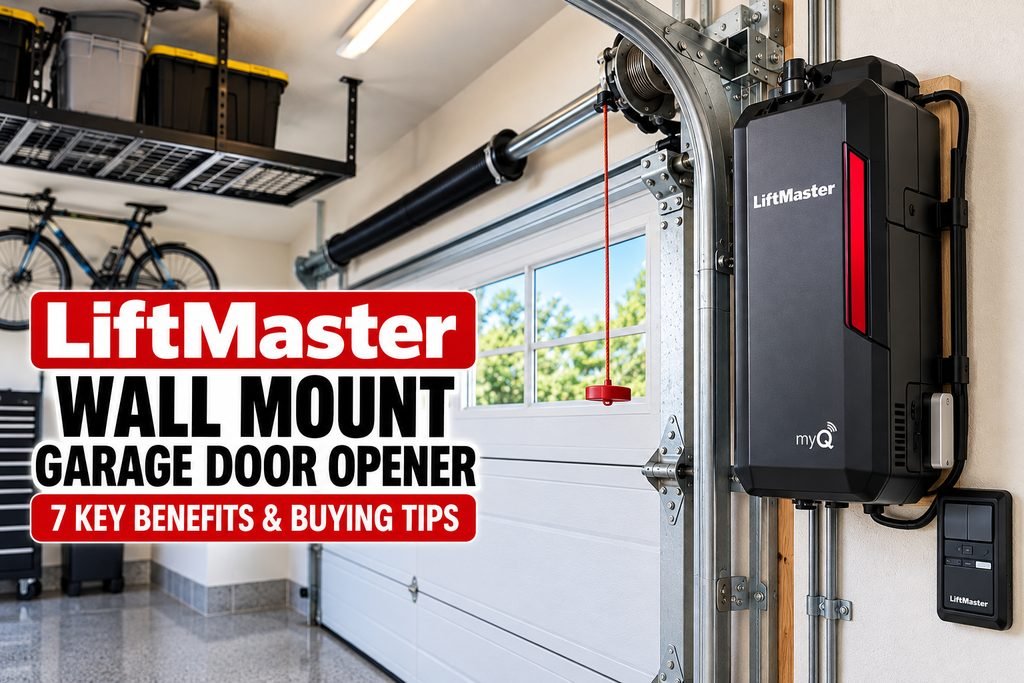
A LiftMaster wall mount garage door opener changes the way a residential garage door can be automated by moving the primary operator from the center of the ceiling to the side of the garage door. This arrangement can be especially useful when homeowners want to preserve overhead space for storage, lighting, bicycles, shelving, or other equipment.
Instead of using the long center rail associated with many traditional trolley systems, a LiftMaster wall mount garage door opener works beside the garage door and operates through the torsion shaft. The result is a different mechanical layout that can provide a cleaner use of the garage ceiling.
Choosing a LiftMaster wall mount garage door opener still requires careful compatibility checking. The door type, torsion arrangement, available side clearance, mounting surface, dimensions, electrical requirements, and model-specific specifications all matter.
Table of Contents
- What Is a LiftMaster Wall Mount Garage Door Opener?
- How the Side-Mounted System Operates
- 7 Benefits Worth Considering
- How It Changes Garage Ceiling Space
- Important Features to Examine
- Checking Garage Door Compatibility
- Installation Requirements
- Models and Related Products
- Wall Mount vs Traditional Opener
- Buying Checklist
- Common Selection Mistakes
- Maintenance Considerations
- Frequently Asked Questions
- Final Thoughts

What Is a LiftMaster Wall Mount Garage Door Opener?
A LiftMaster wall mount garage door opener is a side-mounted automatic operator designed for compatible residential garage doors. Rather than pulling the door along a center-mounted overhead rail, the operator is positioned beside the garage door and works with the torsion shaft.
This makes a LiftMaster wall mount garage door opener part of the jackshaft style of garage door operation. The motor turns the drive mechanism connected to the torsion assembly, which allows the garage door to move through its normal opening and closing cycle.
For homeowners researching the technology behind this arrangement, our article on what is a jackshaft garage door opener provides additional background.
The side-mounted configuration is one of the main reasons a LiftMaster wall mount garage door opener attracts attention in garages where overhead space is important.
How the Side-Mounted System Operates
The basic principle behind a LiftMaster wall mount garage door opener is straightforward. The motor is installed near the side of the garage door, where it connects with the torsion shaft and associated drive components.
When the operator receives an opening command, the motor activates the drive mechanism. The torsion shaft rotates, allowing the compatible garage door system to raise the door.
During closing, the process works in reverse. The operator controls the movement while the garage door’s springs, cables, drums, rollers, hinges, and tracks remain essential parts of the overall system.
A LiftMaster wall mount garage door opener therefore should not be treated as an isolated motor. Proper door balance and mechanical condition remain important for reliable operation.
Safety reminder: Garage door torsion springs can store substantial mechanical energy. Do not attempt spring adjustment or replacement unless you have the appropriate training and equipment. Professional assistance is recommended for hazardous spring and cable work.
7 Benefits Worth Considering
1. More Open Central Ceiling Space
One of the most noticeable advantages of a LiftMaster wall mount garage door opener is the absence of the conventional center-mounted operator rail.
That can make the middle of the garage ceiling easier to use for storage, lighting, hanging equipment, or other household purposes.
2. Side-Mounted Motor Placement
A LiftMaster wall mount garage door opener places the motor beside the garage door. For certain garage layouts, this can create a cleaner arrangement than placing a motor and rail through the middle of the ceiling.
3. Useful for Storage-Focused Garages
If a homeowner relies heavily on overhead storage, a LiftMaster wall mount garage door opener may help preserve valuable ceiling real estate.
This can be useful in garages containing storage racks, hanging bicycles, seasonal equipment, or large lighting fixtures.
4. Modern Connectivity Options
Depending on the model, a LiftMaster wall mount garage door opener may support connected features that allow homeowners to monitor or control their garage door through compatible systems.
For more information about connected operators, see our supporting article myQ compatible garage door openers.
5. Potential Battery Backup Support
Some residential operators support battery backup. When available and correctly installed, this can provide an operating option when household power is unavailable.
Our related article battery backup for garage opener covers this topic in greater detail.
6. Integrated Security Features
A LiftMaster wall mount garage door opener can be paired with compatible controls, safety systems, and locking equipment depending on the selected model.
These components can form part of a broader garage access system rather than simply acting as a motor.
7. A Different Solution for Certain Garage Layouts
Not every garage is arranged ideally for a traditional center-mounted operator. A LiftMaster wall mount garage door opener provides an alternative configuration when the garage door and torsion system meet the necessary requirements.
How It Changes Garage Ceiling Space
The ceiling advantage is one of the clearest reasons to investigate a LiftMaster wall mount garage door opener.
A traditional trolley opener commonly requires a rail extending from the garage door toward the center or rear of the garage. That rail occupies overhead space.
With a LiftMaster wall mount garage door opener, the main operator is relocated to the side. The central ceiling can therefore remain more open.
This can be particularly useful for garages containing:
- Overhead storage systems.
- Hanging bicycles.
- Large ceiling lights.
- Suspended shelving.
- Sports equipment.
- Recreational equipment.
- Other ceiling-mounted storage solutions.

Important Features to Examine
Smart Connectivity
A modern LiftMaster wall mount garage door opener may offer connected functionality depending on the model. Homeowners interested in smartphone control should verify the exact compatibility information for the operator being considered.
Do not assume every LiftMaster model provides identical connectivity features.
Battery Backup
A LiftMaster wall mount garage door opener with compatible battery backup can provide an additional operating option during a power interruption.
The availability and specifications of backup systems vary, so the model documentation should be checked before purchase.
Safety Sensors
Garage door operators use safety systems designed to respond when an obstruction is detected. A LiftMaster wall mount garage door opener should be installed and tested according to the manufacturer’s instructions.
Lighting
Lighting can be another important feature when comparing a LiftMaster wall mount garage door opener. Integrated lighting can provide illumination around the garage access area without requiring the same type of traditional overhead opener light.
Locking Options
Some side-mounted systems can work with compatible automatic locking equipment. Confirm the exact accessories and requirements for the model you select.
Checking Garage Door Compatibility
Before purchasing a LiftMaster wall mount garage door opener, check the garage door rather than selecting a model based solely on brand recognition.
Important compatibility factors include:
- Garage door type.
- Door width.
- Door height.
- Door weight.
- Torsion shaft arrangement.
- Drum configuration.
- Available side clearance.
- Mounting surface.
- Electrical requirements.
- Required safety equipment.
A LiftMaster wall mount garage door opener is not automatically compatible with every sectional garage door. The torsion system and available mounting area are especially important.
The door should also move smoothly. If the door binds, drops, rises unevenly, or shows signs of damaged cables or springs, those mechanical issues should be addressed before installing a new operator.
Installation Requirements
Installing a LiftMaster wall mount garage door opener requires attention to the operator’s position, torsion shaft, mounting surface, electrical connection, controls, and safety equipment.
The mounting location must be structurally suitable. The operator also needs to align correctly with the torsion shaft and related drive hardware.
Before installation, examine:
- Structural strength of the mounting area.
- Available side clearance.
- Torsion shaft position.
- Condition of springs and cables.
- Condition of drums and rollers.
- Electrical requirements.
- Safety sensor placement.
- Model-specific installation instructions.
The LiftMaster Residential Jackshaft Operator is one product available for comparison when researching residential side-mounted equipment.
Because garage door springs and cables can be hazardous, professional installation may be appropriate when the work involves torsion hardware, electrical connections, or structural mounting.
Models and Related Products
LiftMaster 98022
The LiftMaster 98022 Garage Door Opener is a product worth reviewing when comparing residential wall-mounted garage door operator options.
When considering a LiftMaster wall mount garage door opener, compare the model’s specifications against the requirements of the actual garage door.
LiftMaster Residential Jackshaft Operator
The LiftMaster Residential Jackshaft Operator is another relevant product for homeowners researching side-mounted residential garage door operation.
Genie 6070H
The Genie 6070H provides another manufacturer option for comparison.
Comparing alternatives can help clarify differences between a LiftMaster wall mount garage door opener and other jackshaft-style products.
Guardian 928V
The Guardian 928V Jackshaft Pro Series is another product that can be reviewed alongside LiftMaster equipment.
When comparing products, focus on compatibility, installation requirements, controls, connectivity, backup power, and other features that actually matter to the intended garage.
Wall Mount vs Traditional Opener
| Consideration | LiftMaster Wall Mount Garage Door Opener | Traditional Trolley Opener |
|---|---|---|
| Operator location | Beside the garage door | Generally overhead |
| Central ceiling rail | Not used in the same conventional arrangement | Normally required |
| Side clearance | Important | Less central to motor placement |
| Torsion shaft | Directly involved in the operating arrangement | Uses trolley and rail mechanics |
| Overhead storage | Can preserve more central ceiling space | Rail occupies overhead space |
| Compatibility | Requires appropriate door and torsion configuration | Depends on trolley system and door setup |
The table illustrates why a LiftMaster wall mount garage door opener may appeal to homeowners with specific garage-space requirements. However, neither configuration is automatically suitable for every garage.
Buying Checklist
Before ordering a LiftMaster wall mount garage door opener, work through the physical and technical requirements of the garage.
Measure Side Clearance
Because the motor is mounted beside the garage door, confirm that the available side space can accommodate the operator and required hardware.
Check the Torsion Shaft
A LiftMaster wall mount garage door opener depends on the correct relationship between the operator and torsion assembly. Confirm the shaft configuration before ordering.
Inspect the Door
Check the tracks, rollers, hinges, cables, drums, springs, and door balance before adding a new operator.
Review Connectivity
If smartphone control or smart-home integration matters, verify the exact features of the chosen LiftMaster wall mount garage door opener.
Consider Backup Power
Homeowners who experience power outages may want to check whether the selected LiftMaster wall mount garage door opener supports an appropriate battery backup solution.
Check Included Accessories
Confirm which remotes, wall controls, sensors, lighting components, mounting hardware, or backup equipment are included with the specific model.
Common Selection Mistakes
Choosing Without Measuring
One of the easiest mistakes is ordering a LiftMaster wall mount garage door opener before confirming side clearance and torsion-shaft dimensions.
Ignoring Door Balance
An operator is not designed to compensate for a fundamentally damaged or badly balanced garage door. Correct the underlying mechanical problem first.
Assuming Every Model Is Identical
Different LiftMaster models can have different specifications and feature sets. Always review the exact model documentation.
Forgetting Electrical Requirements
A LiftMaster wall mount garage door opener must have an appropriate electrical supply installed according to applicable requirements and manufacturer instructions.
Doing Hazardous Spring Work
Torsion springs and cables can contain significant stored energy. Avoid attempting specialized spring work without appropriate professional training.
Maintenance Considerations
Routine inspection remains important after installing a LiftMaster wall mount garage door opener.
Pay attention to:
- Door balance.
- Spring condition.
- Cable condition.
- Drums.
- Tracks.
- Rollers.
- Hinges.
- Mounting hardware.
- Safety sensors.
- Wall controls.
Changes in noise, movement, balance, or operating behavior can indicate a problem with the garage door system rather than the motor alone.

Frequently Asked Questions
What does a LiftMaster wall mount garage door opener do?
A LiftMaster wall mount garage door opener automates a compatible residential garage door by operating from the side of the door and working with the torsion shaft.
Does a LiftMaster wall mount garage door opener require an overhead rail?
No conventional center rail is required in the same manner as a traditional trolley system. The side-mounted arrangement uses a different operating mechanism.
Can I use a LiftMaster wall mount garage door opener on any garage door?
No. A LiftMaster wall mount garage door opener requires a compatible door and appropriate torsion, mounting, clearance, and electrical conditions.
Why choose a wall-mounted LiftMaster instead of a ceiling opener?
A LiftMaster wall mount garage door opener can preserve more central ceiling space, which may be useful when the garage contains overhead storage, lighting, or other equipment.
Does a LiftMaster wall mount garage door opener support smart controls?
Some models provide smart connectivity. Verify the exact features of the LiftMaster wall mount garage door opener you are considering rather than assuming all models have identical capabilities.
Can a LiftMaster wall mount garage door opener work during a blackout?
If the selected LiftMaster wall mount garage door opener supports a compatible battery backup and that system is installed correctly, operation may be available during a power interruption.
Where does a LiftMaster wall mount garage door opener go?
The operator is installed beside the garage door, normally near the torsion shaft and on an appropriate structural mounting surface.
Is professional installation recommended?
Professional installation can be appropriate for a LiftMaster wall mount garage door opener when the project involves torsion springs, cables, electrical connections, or structural mounting.
Final Thoughts
A LiftMaster wall mount garage door opener provides an alternative to the conventional overhead trolley arrangement by positioning the operating motor beside the garage door.
For garages where ceiling space is valuable, a LiftMaster wall mount garage door opener can provide a practical way to automate a compatible door while keeping the central ceiling area more open.
The key is to select the system according to the actual garage. Check the door dimensions, torsion shaft, side clearance, mounting surface, electrical requirements, smart features, backup-power options, and manufacturer specifications before purchasing.
If you want to understand the technology behind this style of operator, continue to what is a jackshaft garage door opener. You can also compare alternatives in our best wall mounted garage door opener article.
For available products, visit the jackshaft garage door opener category.
Manufacturer Resources