
Uncategorized
LIFTMASTER GATE OPENER INSTALLATION
Sep
LiftMaster Gate Opener Installation
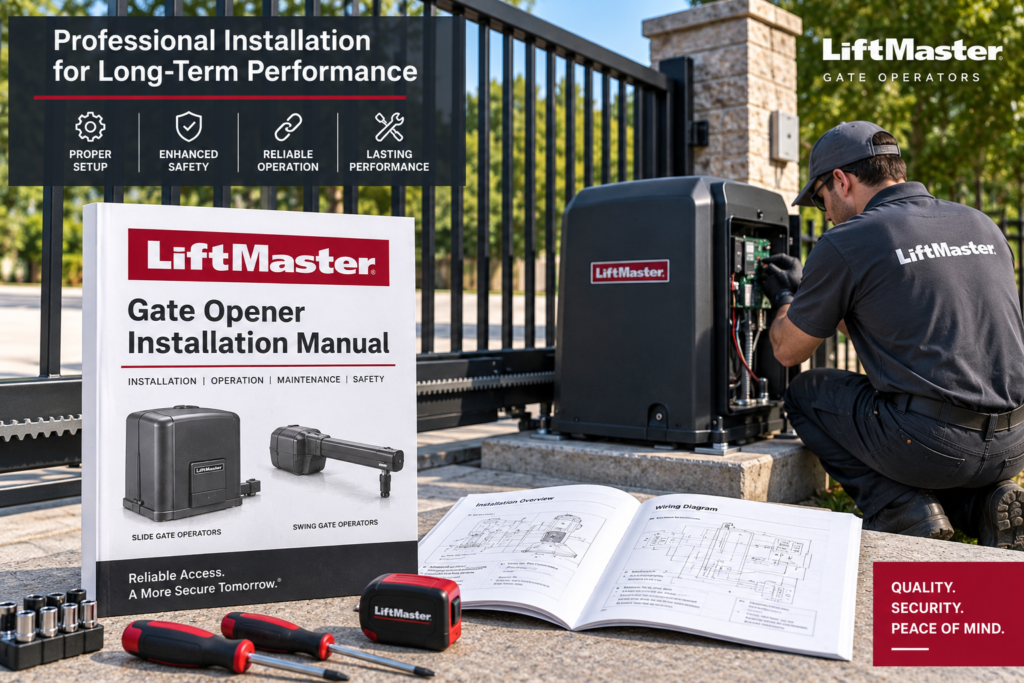
LiftMaster gate opener installation requires more than mounting an operator and connecting a power source. The gate, operator, controls, wiring, safety equipment, and access area all need to be considered as part of the complete automated gate system. The correct installation procedure also depends on the specific LiftMaster model and the application.
This guide explains the major stages involved in LiftMaster gate opener installation, including preparation, operator selection, mounting, wiring, safety devices, programming, testing, and maintenance. Always use the installation documentation for the exact LiftMaster model being installed and follow applicable electrical, building, and gate-safety requirements.
For available gate operators and related equipment, visit our Gate & Fence Operators category.

LiftMaster Gate Opener Installation: What to Check First
Before beginning a LiftMaster gate opener installation, identify the exact operator model and determine whether it is designed for the gate application. LiftMaster offers different operators for swing gates, slide gates, residential applications, commercial applications, and industrial environments.
The operator model should be confirmed before following installation instructions. Do not assume that instructions for one LiftMaster gate operator apply to another model simply because the equipment looks similar.
| Installation Check | Why It Matters |
|---|---|
| Operator model | Determines which installation manual and procedures apply. |
| Gate type | Confirms whether the system is intended for a swing or slide gate. |
| Gate condition | The gate should operate properly before automation equipment is installed. |
| Power source | Determines the applicable electrical installation requirements. |
| Entrapment zones | Helps determine the safety protection required for the installation. |
| Access controls | Determines which control devices and wiring are appropriate. |
1. Identify the Correct LiftMaster Operator
The first step in LiftMaster gate opener installation is selecting and identifying the correct operator. A slide gate and a swing gate require different operator configurations, so the gate type should be established before purchasing or installing equipment.
For example, LiftMaster offers commercial slide gate operators such as the CSL24UL and industrial slide gate operators such as the IHSL24UL. The manufacturer provides model-specific installation manuals and technical documents for these products.
You can review the LiftMaster IHSL24UL if you are researching an industrial slide gate operator.
For a residential application, the LiftMaster LA400 Dual Gate Opener is another product available for research.
2. Inspect the Gate Before Installation
An automated gate operator should not be expected to correct mechanical problems with a gate. Before beginning installation, inspect the gate and its supporting hardware.
The gate should be evaluated for proper movement, physical damage, excessive friction, obstruction, and other conditions that could affect operation. A gate that is difficult to move manually may create problems for an automated operator.
Check the hinges, rollers, tracks, posts, stops, and other mechanical components appropriate to the gate design. Any mechanical defects should be addressed before the operator is installed.
This preparation stage is important because the operator is designed to automate gate movement; it is not a replacement for a properly functioning gate.
3. Review the LiftMaster Installation Manual
Before mounting anything, read the documentation supplied for the exact operator. The LiftMaster gate opener installation procedure can vary significantly between models.
Model-specific documentation can provide information about mounting, wiring, controls, limits, adjustments, safety equipment, programming, and testing.
For example, LiftMaster’s official IHSL24UL page currently provides an installation manual, product guide, wiring diagram, product data sheets, and other technical documentation for the model. View the official LiftMaster IHSL24UL resources.
Review the documentation before beginning the physical installation rather than trying to determine the procedure after the operator has already been mounted.
4. Prepare the Installation Area
Once the gate and operator have been identified, prepare the installation area according to the manufacturer’s requirements.
The exact preparation will depend on the operator. Some operators are mounted to a prepared pad or other supporting structure, while others use different mounting arrangements. The manufacturer’s installation documentation should determine the appropriate mounting method.
Make sure the installation location provides sufficient clearance for the gate and operator components. Consider the movement of the gate, access to the operator for service, electrical routing, and the location of safety devices.
Do not improvise mounting dimensions or structural requirements. Use the model-specific installation manual for the exact measurements and mounting instructions.
5. Mount the Operator Correctly
Proper mounting is a critical part of LiftMaster gate opener installation. The operator needs to be installed according to the manufacturer’s instructions and aligned appropriately with the gate mechanism.
For slide gates, the operator and gate drive system must be positioned according to the applicable model documentation. For swing gates, the operator arm or actuator must be installed according to the manufacturer’s specified geometry and mounting points.
The exact mounting dimensions should never be guessed. Different operators have different installation requirements, and incorrect positioning can affect operation and equipment performance.

6. Install the Electrical Connections
Electrical work should follow the installation documentation for the specific operator and applicable local requirements.
During LiftMaster gate opener installation, the wiring arrangement may include the operator power supply, control devices, safety devices, accessories, and other system components.
Do not assume that the terminal layout or wiring procedure is identical between different LiftMaster models. Use the wiring diagram provided for the exact operator.
If the installation involves electrical work beyond your qualifications, use an appropriately qualified professional. Incorrect wiring can damage equipment and create safety hazards.
7. Install the Required Safety Devices
Safety equipment is an essential part of an automated gate system. The appropriate entrapment-protection devices depend on the operator, gate configuration, and entrapment zones present at the installation.
LiftMaster states that gate operator systems must be installed with appropriate entrapment protection and provides resources covering UL 325 requirements. Its official safety page explains that gate operators require appropriate safety devices and that installation should follow applicable UL 325 and ASTM F2200 requirements. Review LiftMaster’s official gate safety resources.
LiftMaster’s UL compliance resources also explain that the required protection depends on the specific application and the entrapment zones present. View LiftMaster UL-compliant access system information.
Do not treat safety devices as optional accessories. They are part of the complete automated gate system and must be installed and tested according to the applicable requirements.
Programming After LiftMaster Gate Opener Installation
Once the operator and required components have been installed, the next stage may involve programming controls and accessories.
Depending on the system, this can include remote controls, keypads, access-control equipment, loop detectors, photo eyes, monitored safety devices, or other accessories.
The programming procedure depends on the exact operator and accessory. Follow the instructions in the appropriate documentation rather than using generic programming steps from another model.
If you need documentation before programming, our LiftMaster Gate Opener Manual guide explains how to locate and use model-specific operator documentation.
Set and Verify Gate Travel
After the operator is installed, the gate travel and operating sequence need to be checked according to the model-specific instructions.
The exact limit-setting or travel-adjustment process varies between operators. Follow the manufacturer’s instructions for the operator being installed.
The gate should move through its intended operating range without unnecessary interference or abnormal mechanical resistance.
If the gate does not operate correctly during testing, stop and investigate the cause rather than repeatedly cycling the system.
Test the Safety System
Testing is one of the most important stages of LiftMaster gate opener installation. The complete system should be tested after installation and before normal use.
Testing should include the gate operator, controls, safety devices, and other equipment installed as part of the system. The exact tests required depend on the operator and installation.
LiftMaster’s safety resources emphasize the importance of properly installed safety devices and professional installation for automated gate systems. The manufacturer’s resources also reference UL 325 and ASTM F2200 requirements for gate safety. :contentReference[oaicite:1]{index=1}
Never bypass a safety device simply to make the gate operate. If a safety device produces a fault or prevents normal operation, identify and correct the underlying issue according to the applicable documentation.
Check Access Controls
After the operator and safety equipment have been tested, verify the access-control equipment associated with the gate.
This can include a keypad, remote control, telephone entry system, card reader, vehicle loop, or other access-control equipment depending on the installation.
Each control should be tested to confirm that it performs the intended function and that the gate responds correctly.
For installations that use a keypad, our Gate Operator Keypad guide provides additional information about gate access controls.
LiftMaster Gate Opener Installation for Slide Gates
Slide gate systems use a different operating arrangement from swing gates. The operator works with the gate’s sliding movement and associated drive components.
When completing LiftMaster gate opener installation on a slide gate, pay particular attention to the gate track, rollers, operator position, drive components, access area, and entrapment zones.
LiftMaster’s CSL24UL product page provides model-specific installation documentation, wiring information, product guides, and troubleshooting resources. View the official LiftMaster CSL24UL resources.
The exact installation procedure should always come from the documentation for the selected operator.
LiftMaster Gate Opener Installation for Swing Gates
Swing gates use arms or actuators to move the gate through its opening and closing path. Installation therefore requires attention to the operator mounting location, gate geometry, hinges, stops, and entrapment zones.
Before installing a swing gate operator, make sure the gate moves correctly by hand and that its mechanical components are in appropriate condition.
Do not select mounting points based only on appearance. Use the exact dimensions and installation procedure supplied for the operator.
For a residential dual swing gate application, you can review our LiftMaster LA400 Dual Gate Opener product page.
Common LiftMaster Installation Mistakes
| Mistake | Why It Can Cause Problems |
|---|---|
| Using the wrong manual | Installation procedures can differ between operator models. |
| Automating a poorly functioning gate | Mechanical problems can affect automated operation. |
| Guessing mounting dimensions | Incorrect positioning can affect gate movement and operator performance. |
| Ignoring safety devices | Entrapment protection is an essential part of the gate system. |
| Guessing wiring connections | Incorrect wiring can damage components or create hazards. |
| Skipping final testing | Installation problems may remain undiscovered before normal use. |
Maintenance After Installation
Completing LiftMaster gate opener installation is not the end of the process. The gate system should be maintained and inspected according to the manufacturer’s documentation and applicable requirements.
Regular inspection can help identify changes in gate movement, damaged components, unusual noises, or problems with safety equipment.
Keep the installation manual and other technical documentation available so that future maintenance can be performed using information specific to the installed operator.
If a problem develops, our LiftMaster Gate Opener Troubleshooting guide can be used as a starting point for understanding common troubleshooting areas.

Official LiftMaster Installation Resources
For installation work, use official manufacturer documentation whenever possible. The following LiftMaster resources were selected because they are current manufacturer pages containing product and technical information.
- LiftMaster Gate Safety and UL 325 Resources
- LiftMaster CSL24UL Product and Installation Resources
- LiftMaster IHSL24UL Product and Installation Resources
- LiftMaster UL-Compliant Access Systems
Related Gate Operator Guides
- Gate Opener Battery — Battery replacement, backup power, and maintenance information.
- LiftMaster Gate Opener Manual — How to find and use model-specific LiftMaster documentation.
- LiftMaster Gate Opener Troubleshooting — Troubleshooting information for LiftMaster gate operator systems.
- Gate Operator Keypad — Information about keypad-based gate access.
- Heavy Duty Swing Gate Opener Guide — Factors to consider when researching heavy-duty swing gate operators.
Frequently Asked Questions
How do I start a LiftMaster gate opener installation?
Start by identifying the exact operator model, confirming that it is appropriate for the gate, inspecting the gate’s mechanical condition, and reviewing the manufacturer’s installation documentation before mounting or wiring the operator.
Can I use any LiftMaster installation manual?
No. Use the manual intended for the exact operator model whenever possible. Different LiftMaster operators can have different mounting, wiring, programming, adjustment, and safety procedures.
Should the gate work properly before installing the operator?
Yes. The gate’s mechanical operation should be checked before automation. Problems with hinges, rollers, tracks, stops, or other mechanical components can affect automated operation.
Does LiftMaster gate opener installation require safety devices?
Automated gate systems require appropriate entrapment protection based on the installation and applicable requirements. LiftMaster provides UL 325 and gate-safety resources explaining the role of monitored safety devices and entrapment protection.
Can I install a LiftMaster gate opener myself?
The appropriate installation method depends on the operator and application. Because gate operators involve moving equipment, electrical components, and safety systems, qualified professional installation may be appropriate, particularly for complex commercial or industrial installations.
How do I know where to mount the operator?
Use the mounting dimensions and procedures specified in the installation manual for the exact operator. Do not estimate mounting positions based on another model.
What should I do after installing the operator?
Complete the applicable programming, adjustment, safety-device checks, access-control testing, and operational testing described in the manufacturer’s documentation before placing the gate into normal service.
Where can I find LiftMaster installation documentation?
LiftMaster provides model-specific installation manuals and technical documents through its official product pages. Identify the operator model first and then locate the corresponding manufacturer resources.
What if the gate operator does not work after installation?
Stop repeated operation and review the installation, wiring, safety devices, programming, and diagnostic information for the exact model. If the problem involves electrical or safety equipment, use a qualified technician when appropriate.
How often should a LiftMaster gate operator be maintained?
Follow the maintenance information supplied for the exact operator and inspect the complete gate system regularly. Maintenance requirements can vary according to the operator, gate, traffic level, environment, and application.
Final Takeaway
A successful LiftMaster gate opener installation starts with selecting the correct operator and understanding the gate application. From there, the installation should follow the model-specific documentation and include proper mechanical preparation, mounting, wiring, safety equipment, programming, and testing.
Do not rely on generic installation instructions when model-specific documentation is available. LiftMaster provides product manuals and technical resources for its operators, while its safety resources explain important considerations surrounding UL 325 and entrapment protection.
After installation, keep the documentation available and maintain the gate system according to the manufacturer’s instructions. For additional information, continue with our LiftMaster Gate Opener Manual guide or visit our Gate & Fence Operators category.
