
Uncategorized
Garage Door Drive Belt Replacement
Oct
Garage Door Drive Belt Replacement: 7 Essential Tips for a Reliable Repair
A garage door drive belt replacement can restore proper operation when the belt in a compatible belt-drive opener becomes worn, damaged, stretched, or otherwise unsuitable for continued service. The belt is an important part of the opener’s drive system because it transfers movement from the motor and drive assembly to the trolley.
Before starting a garage door drive belt replacement, it is important to identify the exact opener model and verify the correct replacement assembly. Belt assemblies can look similar while having different lengths, configurations, or compatibility requirements.
This guide explains how to recognize belt problems, identify the correct replacement, prepare for the repair, understand the components involved, and avoid common mistakes during a garage door drive belt replacement.
Table of Contents
- What Is a Garage Door Drive Belt?
- When Should the Belt Be Replaced?
- 7 Signs the Belt May Need Replacement
- How to Identify the Correct Replacement
- Preparing for Belt Replacement
- Garage Door Drive Belt Replacement Considerations
- Common Replacement Mistakes
- Related Belt Assemblies
- Maintaining the Drive System
- Belt Replacement Comparison
- Related Garage Door Resources
- Safety Considerations
- Frequently Asked Questions
- Conclusion

What Is a Garage Door Drive Belt?
The drive belt is the flexible component used in many belt-drive garage door openers to transfer mechanical movement from the opener’s drive mechanism to the trolley. Instead of using a metal chain, the system uses a reinforced belt designed for the particular opener.
A garage door drive belt replacement becomes necessary when the existing belt no longer meets the manufacturer’s requirements for reliable operation.
The belt works together with the motor, drive sprocket, pulleys, rail, trolley, and related hardware. Because these components operate together, diagnosing the entire drive system is important before ordering a replacement.
Important: Always identify the exact opener model before purchasing a belt. A replacement should be selected using the manufacturer’s compatibility information rather than appearance alone.
When Should the Belt Be Replaced?
A garage door drive belt replacement may be appropriate when the existing belt has visible damage, abnormal wear, or another condition identified by the manufacturer as requiring replacement.
Normal age does not automatically mean that every belt needs to be replaced. Usage frequency, operating environment, installation, maintenance, and the specific opener model can affect service life.
A belt that is visibly damaged should not simply be ignored because the opener still operates. Continuing to use a damaged drive component can create additional operating problems.
Likewise, unusual noise does not automatically prove that the belt is defective. The motor, sprocket, pulley, trolley, rail, mounting hardware, or garage door itself can also cause unusual sounds.
7 Signs the Belt May Need Replacement
1. Visible belt damage
Inspect the belt for obvious damage, deterioration, broken sections, or other abnormal conditions. Visible damage is one of the clearest reasons to investigate whether a garage door drive belt replacement is required.
2. Unusual operating noise
A sudden change in operating noise may indicate a problem somewhere in the opener drive system. The belt should be inspected together with the pulley, sprocket, motor, rail, and trolley.
3. Jerky movement
Irregular trolley movement can be associated with a worn drive belt, but other components can create similar symptoms. Proper diagnosis should come before ordering a garage door drive belt replacement.
4. Belt tracking problems
If the belt does not track correctly through the drive system, inspect the complete assembly. Misalignment or a damaged component may be responsible.
5. Repeated operating problems
Repeated opener problems can justify a more detailed inspection of the drive system and may eventually lead to a garage door drive belt replacement if the belt is confirmed to be the problem.
6. Unusual vibration
Excessive vibration can originate from the motor, rail, pulley, sprocket, trolley, mounting hardware, or belt assembly.
7. Manufacturer-recommended replacement
If the manufacturer’s parts information identifies the belt as a replacement item for the particular opener, use that information when determining whether a garage door drive belt replacement is appropriate.
How to Identify the Correct Replacement
Correct compatibility is one of the most important parts of a garage door drive belt replacement. Do not order a belt simply because it looks similar to the existing one.
Start by locating the opener’s model number. Depending on the opener, the model information may appear on the motor housing, identification label, owner’s manual, or parts documentation.
Also record the existing replacement-part number if one is available. This can make product identification considerably easier.
- Opener manufacturer
- Exact model number
- Existing belt or assembly part number
- Garage-door height
- Rail configuration
- Belt configuration
- Manufacturer compatibility information
- Replacement instructions
LiftMaster’s official parts resource lists belt kits for specific opener applications and advises customers to check the owner’s manual or replacement-parts diagram before ordering. LiftMaster Replacement Parts.
Preparing for Belt Replacement
Good preparation makes a garage door drive belt replacement easier and reduces the possibility of ordering the wrong part.
Confirm the opener model
Do not begin by searching only for a generic garage door belt. Start with the exact opener model.
Confirm the belt assembly
Some replacement products are supplied as complete assemblies rather than as an individual belt. Verify what is included before ordering.
Review the parts diagram
A parts diagram can show the relationship between the belt, pulley, sprocket, trolley, and rail. This is especially useful when planning a garage door drive belt replacement.
Read the manufacturer’s instructions
Replacement procedures vary between opener models. Use the manufacturer’s instructions for the specific opener rather than applying a generic procedure.
Garage Door Drive Belt Replacement Considerations
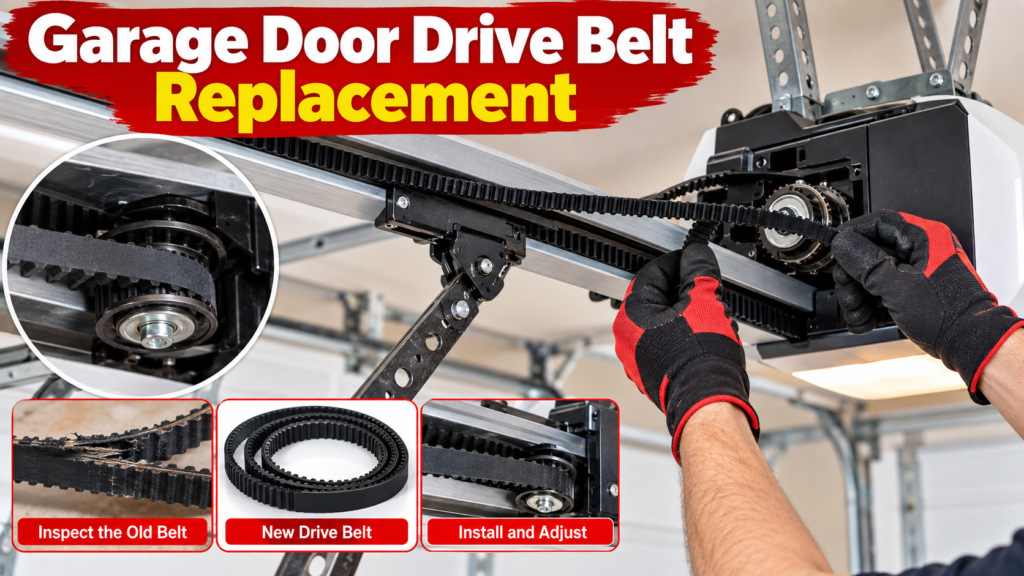
The exact steps for a garage door drive belt replacement vary according to the opener model and belt assembly. The following overview explains the process without replacing the manufacturer’s model-specific instructions.
- Identify the exact opener model.
- Verify the correct replacement belt assembly.
- Review the manufacturer’s instructions.
- Prepare the opener according to the manufacturer’s procedure.
- Inspect the existing drive components.
- Remove the existing belt according to the model-specific instructions.
- Install the replacement belt correctly.
- Check the belt routing and alignment.
- Make required adjustments according to the manual.
- Test the opener and safety functions.
Do not guess the correct belt tension or routing. The manufacturer’s procedure should determine how the replacement is installed and adjusted.
Common Replacement Mistakes
Choosing by appearance
Two belts can appear almost identical while being intended for different opener models. Always verify compatibility.
Ignoring the opener model
The opener model is one of the most useful pieces of information when selecting a replacement.
Replacing the belt without checking other components
A damaged pulley, sprocket, trolley, rail, or mounting component can cause symptoms that resemble a belt problem.
Using incorrect adjustment
Incorrect adjustment during a garage door drive belt replacement can affect the operation of the opener. Follow the model-specific instructions.
Ignoring the garage door itself
The automatic opener is designed to move the garage door, but problems with the door, tracks, rollers, springs, or hardware can affect opener performance.
Related Belt Assemblies
The following products are selected from the belt product pool for this cluster. Compatibility must be verified against the exact opener model before ordering.
41A5250 Belt Assembly
The 41A5250 Belt Assembly is a related belt-drive replacement component that can be considered when the opener model requires this part.
Linear HAE00033 Belt Assembly
The Linear HAE00033 Belt Assembly is another belt assembly in the supplied product collection. Confirm the opener model and parts information before ordering.
Genie 37561R-S Belt Assembly
The Genie 37561R-S Belt Assembly is a Genie belt assembly that should be matched to the appropriate compatible opener before a garage door drive belt replacement.
LiftMaster 41A3589-1 Belt Assembly
The LiftMaster 41A3589-1 Belt Assembly is an 8-foot belt assembly. LiftMaster identifies 041A3589-1 as an 8-foot replacement kit for certain LiftMaster and Chamberlain belt-drive openers and recommends checking the owner’s manual or parts diagram for compatibility.
LiftMaster 41A5434-11 Belt Assembly
The LiftMaster 41A5434-11 Belt Assembly is included in the supplied belt product pool and should be matched to the correct opener model before purchase.
LiftMaster 41A5434-13 Belt Assembly
The LiftMaster 41A5434-13 Belt Assembly is another supplied replacement option. Verify compatibility before beginning a garage door drive belt replacement.
LiftMaster 41A5434-14 Belt Assembly
The LiftMaster 41A5434-14 Belt Assembly is included in the available product collection for compatible applications.
Compatibility reminder: A belt assembly should only be ordered after the opener model and applicable parts information have been confirmed.
Maintaining the Drive System
Proper maintenance can help identify problems before they become more serious. Follow the opener manufacturer’s maintenance instructions rather than applying generic procedures.
Inspect the belt
Look for visible damage or abnormal conditions that may indicate the need for a garage door drive belt replacement.
Inspect the pulley
The pulley works with the belt and should be checked when diagnosing belt-related operating problems.
Inspect the drive sprocket
A worn sprocket can affect belt movement and create symptoms that may initially appear to be belt-related.
Inspect the rail and trolley
The trolley should move correctly along the rail. Binding or abnormal movement can affect the drive system.
Check the garage door
A garage door that binds or has damaged hardware can place additional load on the opener.
For information about related pulley problems, visit Garage Door Pulley Repair.
Belt Replacement Comparison
| Situation | What to Check | Recommended Approach |
|---|---|---|
| Visible belt damage | Belt and surrounding drive components | Verify the correct replacement assembly. |
| Unusual noise | Belt, pulley, sprocket, motor and trolley | Diagnose the complete system before ordering. |
| Wrong belt suspected | Model number and parts diagram | Confirm compatibility before installation. |
| Repeated belt problems | Belt alignment and other drive components | Investigate the underlying cause. |
| New replacement required | Replacement part number | Follow manufacturer installation instructions. |
Related Garage Door Resources
- Belt Drive Garage Door Opener
- Chain Drive Garage Door Openers
- Garage Door Belt Replacement
- Garage Door Pulley Repair
For the main belt-replacement category, visit Garage Door Belt Replacement.
Safety Considerations
A garage door opener moves a heavy door through an automated system. Any garage door drive belt replacement should therefore be performed according to the manufacturer’s instructions.
The U.S. Consumer Product Safety Commission states that automatic residential garage door operators are subject to a mandatory federal safety standard, 16 CFR Part 1211. :contentReference[oaicite:1]{index=1}
Do not disable safety-reversing functions to compensate for a mechanical problem.
After servicing the opener, verify operation and safety functions according to the manufacturer’s instructions.
LiftMaster also recommends contacting an authorized dealer when troubleshooting does not resolve an opener problem. LiftMaster repair and maintenance information.
Frequently Asked Questions
What is a garage door drive belt replacement?
A garage door drive belt replacement involves removing a worn or damaged belt assembly and installing the correct compatible replacement according to the opener manufacturer’s instructions.
How do I know if my opener belt needs replacement?
Visible damage, abnormal wear, unusual operation, or manufacturer guidance can indicate that the belt should be inspected and may require a garage door drive belt replacement.
Can I use any garage door opener belt?
No. Belt assemblies are model-specific or application-specific. Always verify the opener model and manufacturer’s compatibility information.
Does unusual noise mean the belt is bad?
Not necessarily. Noise can come from the belt, pulley, sprocket, motor, trolley, rail, mounting hardware, or the garage door itself.
Should I replace the pulley with the belt?
Not automatically. Inspect the pulley and related drive components and replace them only when the appropriate parts information indicates that replacement is necessary.
Why is the opener still noisy after belt replacement?
If the noise remains after a garage door drive belt replacement, another component may be responsible. Inspect the pulley, sprocket, motor, trolley, rail, and garage-door hardware.
How do I find the correct belt?
Start with the opener manufacturer and exact model number. Then compare the replacement part with the manufacturer’s parts diagram or official replacement-parts information.
Can I install a belt without checking the model?
It is not recommended. Confirming compatibility before a garage door drive belt replacement helps prevent ordering and installation errors.
Conclusion
A garage door drive belt replacement can be an important repair when a compatible belt-drive opener has a damaged or worn belt. The key is to identify the exact opener model, verify the correct belt assembly, inspect the surrounding drive components, and follow the manufacturer’s instructions.
Do not select a replacement simply because the belt looks similar to the original. Different opener models can require different belt assemblies, lengths, or configurations.
Before beginning a garage door drive belt replacement, check the model number, replacement part number, parts diagram, and manufacturer’s compatibility information.
After the repair, test the opener and its safety functions according to the manufacturer’s instructions. If the problem continues, the belt may not have been the only component involved.
Final tip: The safest starting point for a garage door drive belt replacement is accurate part identification. Verify the exact opener model before ordering any replacement belt assembly.
