
Uncategorized
LiftMaster Garage Door Opener Not Working
Oct
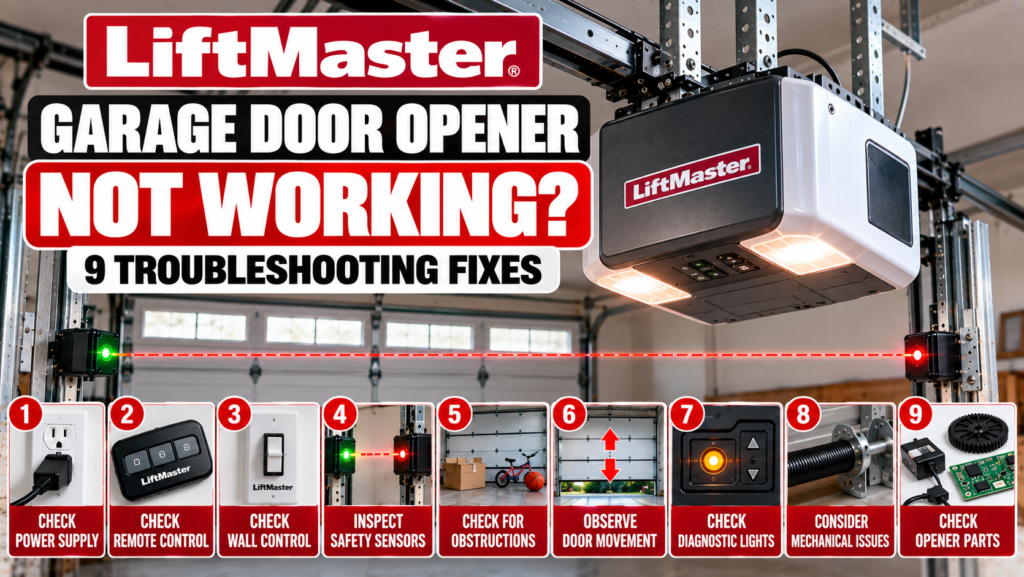
LiftMaster Garage Door Opener Not Working: 9 Troubleshooting Fixes
When a LiftMaster garage door opener is not working, the problem may be caused by something simple such as a depleted remote battery, a power interruption, an obstruction, a safety-sensor issue, or a wall-control problem. In other situations, the problem may involve the opener’s electronics, mechanical components, or the garage door itself.
If your LiftMaster garage door opener is not working, the best starting point is to identify exactly what happens when you activate the opener. Does nothing happen? Does the motor make a sound? Does the light operate? Does the remote respond? Does the wall control respond? Does the door move partway and stop?
This guide explains how to troubleshoot a LiftMaster garage door opener not working situation systematically. Instead of immediately replacing the entire opener, you can begin with the simplest checks and work toward more involved possibilities.
A LiftMaster garage door opener not working does not automatically mean that the opener itself has failed. The symptom can originate from the remote, wall control, safety sensors, electrical supply, garage door, or a specific opener component.
Important: This article provides general troubleshooting information. LiftMaster models can use different controls, diagnostic systems, accessories, and replacement components. Always verify model-specific information against the documentation for your exact opener.
Table of Contents
- What to Check First
- 1. Check the Power Supply
- 2. Check the Remote Control
- 3. Check the Wall Control
- 4. Inspect the Safety Sensors
- 5. Check for Obstructions
- 6. Observe Door Movement
- 7. Check Diagnostic Indicators
- 8. Consider Mechanical Problems
- 9. Check the Opener Parts
- Garage Door Openers and Opener Parts
- Preventive Maintenance
- Related Articles
- Safety Considerations
- Frequently Asked Questions
- Conclusion
What to Check When a LiftMaster Garage Door Opener Is Not Working
When a LiftMaster garage door opener is not working, begin by identifying the exact symptom. A complete lack of response is different from an opener that runs but will not move the door. Likewise, an opener that opens but refuses to close requires a different troubleshooting approach.
If a LiftMaster garage door opener is not working, observe whether the opener has power, whether the lights respond, whether the wall control operates, and whether the remote communicates with the opener.
When troubleshooting a LiftMaster garage door opener not working problem, make one observation or adjustment at a time. This makes it easier to identify the source of the issue.
If the opener motor runs but the door does not move normally, the problem may be mechanical rather than electronic. If the remote does nothing but the wall control works, the remote system deserves attention first.
1. Check the Power Supply
Power should be one of the first checks when a LiftMaster garage door opener is not working. If there is no response from the motor, lights, controls, or diagnostic indicators, determine whether the unit is receiving power before assuming an internal component has failed.
Check the electrical outlet
If your opener uses an accessible electrical outlet, check whether that outlet is supplying power. A power interruption can make a LiftMaster garage door opener not working appear to be an opener failure when the actual issue is upstream.
Check the circuit
If the opener stopped working suddenly, determine whether other equipment connected to the same electrical circuit is also affected.
A breaker that repeatedly trips should not simply be reset repeatedly. Persistent electrical problems require appropriate investigation.
Observe the opener
Look for lights, sounds, or diagnostic indicators. Even a small response can provide useful information when diagnosing a LiftMaster garage door opener not working problem.
2. Check the Remote Control
A remote-control problem can make it seem like a LiftMaster garage door opener is not working when the opener itself may still be operational.
Replace the remote battery
A weak or depleted battery can prevent the remote from communicating properly with the opener. Use the battery type specified for the particular remote.
Check remote programming
If a fresh battery does not solve the problem, verify that the remote is programmed for the opener. Programming procedures vary by model and remote.
Test another control
If available, test the wall control. If the wall control operates the door while the remote does not, the problem may be isolated to the remote, battery, programming, or compatibility.
LiftMaster provides information about its remotes and keypads through its official resources. View LiftMaster remotes and keypads.
If the remote is working but the opener still appears to have a LiftMaster garage door opener not working condition, continue to the wall control and safety-system checks.
3. Check the Wall Control
The wall control is another important point to examine when a LiftMaster garage door opener is not working.
Test the wall control when appropriate and observe whether the opener responds. A wall control that operates the opener can help distinguish a remote problem from an opener problem.
If the wall control works but the remote does not, focus troubleshooting on the remote, battery, programming, or compatibility.
If neither control operates the opener, continue checking power, safety systems, diagnostic indicators, and mechanical conditions.
Inspect accessible connections
Look for obvious damage or disconnection in accessible wiring. Do not randomly move wires or terminals.
If wiring requires service, use the wiring information and procedures for the exact opener model. Incorrect wiring work can create additional problems and may create a safety concern.
4. Inspect the Safety Sensors
Safety sensors are particularly important when a LiftMaster garage door opener is not working correctly during closing.
If the opener opens the door but refuses to close it normally, the safety-reversing system is one area that deserves attention.
Check the sensor path
Look between the two sensor locations for objects that could interrupt the protected area. Boxes, tools, stored equipment, debris, or other objects can interfere with normal operation.
Check sensor alignment
Verify that the sensors are positioned according to the manufacturer’s instructions for your exact opener.
Clean accessible sensor lenses
Dust or dirt on accessible sensor lenses can interfere with normal operation. Carefully clean the lenses and observe the indicators afterward.
Inspect visible wiring
Look for obvious damage to accessible sensor wiring. If the wiring appears damaged or the sensors remain faulty after basic checks, further diagnosis may be necessary.
If you are troubleshooting a LiftMaster garage door opener not working because it refuses to close, do not bypass the safety sensors simply to make the opener operate.
Never bypass the safety sensors. The safety system is an important part of the opener’s protection against entrapment hazards and should remain operational.
5. Check for Obstructions
A blocked garage door path can make a LiftMaster garage door opener not working problem appear more complicated than it actually is.
Inspect the area around the door and make sure objects are not interfering with normal movement.
Check the floor area
Stored items, tools, boxes, vehicles, or other objects should not interfere with the door’s travel path.
Check the track area
Look for obvious objects or conditions that could prevent normal door movement.
Do not force the door through an obstruction. If the door is binding or unusually difficult to move, stop and investigate the underlying condition.
LiftMaster identifies a blocked garage door path as one possible reason an opener may not operate correctly. Review LiftMaster’s garage door opener repair and maintenance guidance.
Removing a simple obstruction may resolve a LiftMaster garage door opener not working situation, but a door that remains difficult to move may require professional inspection.
6. Observe the Garage Door Movement
When a LiftMaster garage door opener is not working, pay close attention to the garage door itself.
Does the door remain completely stationary? Does it move only a few inches? Does it stop before reaching the floor? Does it reverse?
The exact behavior can help determine which part of the system deserves further attention.
| Observed Symptom | Areas to Investigate |
|---|---|
| No response at all | Power, controls, wiring, and diagnostic conditions |
| Remote does not work but wall control does | Remote battery, programming, and compatibility |
| Opener opens but will not close | Safety sensors, obstruction, and closing conditions |
| Door reverses unexpectedly | Safety system, travel conditions, and mechanical resistance |
| Motor runs but door does not move normally | Mechanical connection or garage door components |
| Door is unusually heavy | Garage door mechanical system |
This table is a troubleshooting starting point rather than a definitive diagnosis. A single symptom can have several possible causes.
For example, a LiftMaster garage door opener not working may involve an opener control problem, while unusual door resistance may indicate a garage door mechanical problem.
7. Check Diagnostic Indicators
Many LiftMaster openers provide diagnostic information through indicator lights or other signals. These indicators can help narrow down why a LiftMaster garage door opener is not working.
Diagnostic codes and light patterns can vary between models, so use the documentation for the exact opener rather than applying a code from a different unit.
If your opener displays a flashing pattern, record what you see and compare it with the applicable model documentation.
Do not replace a component solely because an indicator looks unusual. Confirm the meaning of the diagnostic information first.
Correctly interpreting diagnostic information can prevent unnecessary parts replacement when dealing with a LiftMaster garage door opener not working.
8. Consider Mechanical Problems
Sometimes the opener is not the actual source of the problem. A garage door can have mechanical issues that prevent normal opener operation.
Listen for unusual sounds
Grinding, scraping, popping, or other unusual sounds can indicate that further inspection is needed.
Watch the door movement
If the door appears unusually heavy, binds during movement, or does not travel smoothly, the issue may involve the garage door system rather than the opener motor.
A mechanical problem can therefore create symptoms that appear to be a LiftMaster garage door opener not working issue even when the opener itself is functioning.
Consider springs and cables
Garage door springs and cables can be hazardous components. Do not attempt a spring or cable repair unless you have the appropriate qualifications, equipment, and model-specific instructions.
CPSC safety information notes that garage doors that bind or stick, as well as doors that are not properly balanced, should be serviced by a professional. Review the CPSC garage door safety publication.
Important: Do not use opener adjustments as a shortcut for a damaged, binding, or unusually heavy garage door. The underlying mechanical problem should be properly evaluated.
9. Check the Opener Parts
If basic troubleshooting identifies a potentially defective component, the next step is determining whether the component can be replaced and whether the correct replacement is available.
Potential components can include control boards, motors, safety sensors, belt kits, chain kits, limit components, or other model-specific parts.
However, a similar-looking part does not automatically establish compatibility. When a LiftMaster garage door opener is not working, identify the exact model before selecting a replacement part.
LiftMaster provides replacement-parts information covering various categories of opener components. View LiftMaster Replacement Parts.
Always verify the exact opener model and applicable part information before ordering.
If the diagnosis indicates a component issue, replacing the correct component may resolve the LiftMaster garage door opener not working condition without replacing the entire opener.
Garage Door Openers and Opener Parts
Garage Door Openers
If troubleshooting indicates that replacing the complete opener is appropriate, browse our Garage Door Openers category.
Review the available options and verify that the selected opener is appropriate for the specific garage door application before ordering.
Replacing the complete unit should be based on the actual condition of the opener and the requirements of the garage door rather than simply assuming that every LiftMaster garage door opener not working problem requires a new opener.
Garage Door Opener Parts
If the opener can be repaired with a replacement component, browse our Garage Door Opener Parts category.
Verify the exact opener model and part information before ordering. Product availability alone does not establish compatibility.
If compatibility is uncertain, verify compatibility with your exact opener model before ordering.
Preventive Maintenance
Regular maintenance can help identify changes in opener performance before a small issue develops into a larger problem.
- Keep the garage door travel path clear.
- Keep accessible safety sensors clean.
- Watch for unusual sounds.
- Observe changes in door movement.
- Replace remote batteries when necessary.
- Follow the manufacturer’s lubrication instructions.
- Keep the opener model information available.
- Follow the manufacturer’s recommended safety-testing procedures.
- Never bypass safety systems.
Following basic maintenance practices can make it easier to recognize when a LiftMaster garage door opener is not working normally.
Regular observation can also help you identify changes before a complete LiftMaster garage door opener not working situation develops.
Related Articles
Safety Considerations
Garage door safety should take priority over getting the opener running quickly.
- Keep people away from a moving garage door.
- Keep children away from opener controls and moving doors.
- Never bypass safety-reversing sensors.
- Do not stand beneath a moving or unsupported door.
- Do not repeatedly force a door that is binding.
- Do not attempt hazardous spring or cable repairs without proper qualifications.
- Follow the manufacturer’s instructions for your exact opener.
- Have significant mechanical or safety problems professionally evaluated.
Automatic residential garage door operators are subject to federal safety requirements in the United States. The CPSC provides information about applicable automatic residential garage door operator requirements. View CPSC automatic residential garage door operator information.
When basic troubleshooting does not resolve why a LiftMaster garage door opener is not working, professional evaluation may be appropriate, particularly when the problem involves springs, cables, significant mechanical damage, electrical faults, or safety systems.
Frequently Asked Questions
1. Why is my LiftMaster garage door opener not working?
Possible causes include power problems, a remote-control issue, a wall-control problem, safety-sensor conditions, an obstruction, mechanical resistance, or an opener component problem. Start by identifying exactly what happens when you activate the opener.
2. Why is my LiftMaster garage door opener not working even though it has power?
If the opener has power but does not operate the door, check the controls, safety sensors, diagnostic indicators, door movement, and visible mechanical conditions. Power alone does not confirm that every opener component is functioning.
3. Why is my LiftMaster remote not working?
Start by checking the remote battery. If the battery is good, verify programming and compatibility for the specific opener and remote.
4. Why will my LiftMaster opener open the door but not close it?
Check the safety sensors, their alignment, the area between them, and the garage door’s closing path. Do not bypass the safety system.
5. Why does my LiftMaster opener keep reversing?
Reversing can be associated with safety-sensor conditions, obstructions, travel conditions, or mechanical resistance. The exact cause depends on the opener and garage door system.
6. Should I replace my LiftMaster opener if it stops working?
Not necessarily. First determine whether the issue is related to the remote, sensors, controls, power, mechanical conditions, or a replaceable component. Complete replacement may be appropriate in some situations, but the actual problem should be identified first.
7. Can I replace a LiftMaster opener part myself?
Some replacement tasks may be appropriate for a knowledgeable homeowner, but model-specific instructions should always be followed. Spring, cable, major electrical, and other hazardous repairs may require professional service.
8. When should I call a professional?
Seek professional assistance when basic troubleshooting does not resolve the issue or when the problem involves springs, cables, significant mechanical damage, electrical faults, or safety-system concerns.
Conclusion
When a LiftMaster garage door opener is not working, avoid immediately assuming that the entire opener needs to be replaced. Start with the basics: power, remote controls, wall controls, safety sensors, obstructions, door movement, diagnostic indicators, and visible mechanical conditions.
A LiftMaster garage door opener not working situation can have several possible causes, so identifying the exact symptom is an important first step.
Once the symptom is understood, you can make a more informed decision about whether the problem involves a simple control issue, a replacement component, a mechanical problem, or professional service.
If a replacement component is needed, verify the exact model and compatibility information before ordering. You can review available Garage Door Opener Parts or browse Garage Door Openers when replacing the complete opener is appropriate.
For additional troubleshooting information, continue through the related articles above and return to the Garage Door Opener Troubleshooting pillar.
Most importantly, keep the opener’s safety systems functional and follow the manufacturer’s instructions for your exact LiftMaster model when diagnosing a LiftMaster garage door opener not working problem.
