
Uncategorized
Linear Garage Door Opener Troubleshooting
Oct
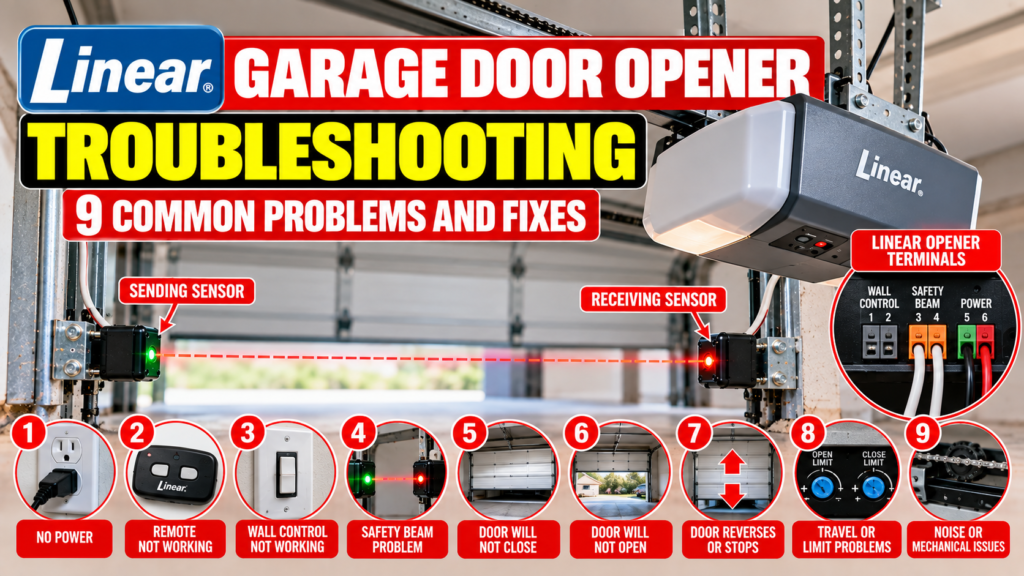
Linear Garage Door Opener Troubleshooting: 9 Common Problems and Fixes
Linear garage door opener troubleshooting is easier when you identify the exact symptom before changing a part or adjusting an opener setting. A Linear opener may stop working because of a power problem, remote-control issue, wall-control problem, safety-beam obstruction, alignment issue, travel setting, mechanical resistance, or another model-specific condition.
This Linear garage door opener troubleshooting guide explains how to approach common operating problems in a logical order. You will learn what to check when the opener has no power, the remote does not work, the wall control is unresponsive, the door will not close, the door will not open, the door reverses, or the opener makes unusual sounds.
Because Linear has produced different opener models, the exact controls, diagnostic indicators, adjustment procedures, and replacement parts can vary. Always compare general troubleshooting information with the owner’s or installation manual for your exact opener model.
Important: This Linear garage door opener troubleshooting guide provides general information. Always follow the manufacturer’s instructions for your exact model before changing wiring, travel settings, force settings, or other components.
Table of Contents
- Linear Garage Door Opener Troubleshooting Basics
- 1. Linear Opener Has No Power
- 2. Remote Control Is Not Operating the Opener
- 3. Wall Control Is Not Working
- 4. Safety Beam or Sensor Problem
- 5. Door Will Not Close
- 6. Door Will Not Open
- 7. Door Reverses or Stops During Travel
- 8. Travel or Limit Problems
- 9. Noise or Mechanical Problems
- Understanding Linear Opener Diagnostics
- Linear Garage Door Opener Maintenance
- Garage Door Openers and Opener Parts
- Related Articles
- Safety Information
- Frequently Asked Questions
- Conclusion
Linear Garage Door Opener Troubleshooting Basics
Good Linear garage door opener troubleshooting starts with observation. Before replacing anything, determine exactly what happens when you press the remote or wall control.
Does the opener remain completely silent? Does the motor operate while the door remains stationary? Does the door begin closing and then reverse? Are the safety-beam indicators showing an unusual condition? Does the wall station work while the remote does not?
These details can narrow the possible causes. Linear garage door opener troubleshooting should therefore begin with the symptom rather than with a replacement part.
Some Linear models include diagnostic functions that communicate operating conditions through lights or sounds. The exact meaning depends on the opener model, which is why the correct manual is important.
Current Nice/Linear documentation includes manuals for multiple garage door opener models. These manuals can contain information about troubleshooting, safety beams, travel limits, force settings, programming, maintenance, and safety-reversal testing.
1. Linear Opener Has No Power
The first step in Linear garage door opener troubleshooting is confirming that the opener actually receives power.
If the opener has no lights, produces no sound, and does not respond to a wall station or remote, investigate the power supply before assuming that the motor or control board has failed.
Check the electrical supply
Inspect the opener’s power connection and the electrical supply serving the opener. If the outlet is controlled by a switch, verify that the switch has not been turned off.
Check whether other equipment connected to the same outlet or circuit is operating normally.
If a circuit breaker repeatedly trips, do not continue resetting it without identifying the reason. A recurring electrical problem may require qualified electrical assistance.
Check opener indicators
Observe any available lights or diagnostic indicators before making adjustments. Linear garage door opener troubleshooting is more accurate when you record what the opener is actually indicating.
Do not automatically assume that a silent opener has a failed motor. Power delivery, controls, wiring, electronics, or another component may be involved.
2. Remote Control Is Not Operating the Opener
Remote-control problems are another common reason for Linear garage door opener troubleshooting.
A remote that does not operate the door does not necessarily mean that the opener itself has failed. Separate the remote problem from the opener problem before ordering replacement parts.
Check the remote battery
A weak or depleted battery can prevent a remote from communicating reliably with the opener. Replace the battery with the correct type specified for that remote and test it again.
Check remote programming
Different Linear opener and remote-control systems can use different programming procedures. Follow the programming instructions for the exact opener and remote combination.
Test another control
If the wall control operates the door but the remote does not, the problem may be isolated to the remote, battery, programming, or receiver communication.
If neither the remote nor wall station operates the opener, continue with broader Linear garage door opener troubleshooting rather than assuming the remote is the only problem.
3. Wall Control Is Not Working
The wall station is another important area to investigate during Linear garage door opener troubleshooting.
First determine whether the opener has power and whether its diagnostic indicators are active.
Inspect accessible wiring
On models using wired wall controls, inspect accessible wiring for obvious damage or disconnection.
Do not randomly move wires between terminals. The correct terminals and wiring arrangement must be verified using documentation for the exact opener model.
Check the control indicators
If the wall station has indicators or buttons that appear inactive, compare its behavior with the manufacturer’s instructions.
Consider the opener model
Linear has produced multiple garage door opener families. Controls, wall stations, programming procedures, and diagnostics can differ between models.
For that reason, Linear garage door opener troubleshooting should always take the exact model number into account.
4. Safety Beam or Sensor Problem
Safety-beam problems are one of the most important areas of Linear garage door opener troubleshooting because the safety system can prevent normal closing when it detects an obstruction or another fault.
Applicable Linear documentation describes safety-beam systems using a sender and receiver. The sender produces an infrared beam that travels across the bottom of the garage door opening toward the receiver.
If the beam is blocked or misaligned during closing, the opener may stop and reverse.
Check for obstructions
Remove boxes, tools, vehicles, stored equipment, or other objects that may block the beam.
Inspect the sensor lenses
Dirt and debris on an accessible sensor lens can interfere with beam operation. Clean the accessible surfaces according to the manufacturer’s recommendations.
Check alignment
The sender and receiver need to face each other correctly. If the receiver does not indicate the expected beam condition, alignment may require attention.
Check accessible wiring
Visible wiring damage, a damaged cable, or a problem at the opener terminals can affect the safety-beam circuit.
Never bypass the safety beam simply to make the opener operate.
5. Door Will Not Close
A door that opens but refuses to close is a common reason homeowners begin Linear garage door opener troubleshooting.
One of the first systems to inspect is the safety-beam circuit.
Check the safety-beam indicators
Check the sender and receiver according to the instructions for your exact model. An obstruction or alignment problem may prevent normal closing.
Check the door path
Make sure nothing is physically obstructing the garage door’s travel path.
Do not immediately increase force
Force settings should not be used to compensate for a sticking, damaged, binding, or improperly balanced garage door.
Linear documentation warns that excessive force can interfere with proper safety operation and create serious hazards.
6. Door Will Not Open
If the door will not open, determine whether the opener is responding to the command. This simple observation can make Linear garage door opener troubleshooting much more efficient.
If the opener is completely silent
Check the power supply, wall station, remote, and applicable diagnostic indicators.
If the motor operates but the door does not move
The problem may involve the connection between the opener and the door, a traveler or trolley, or another mechanical component.
Some Linear openers include a manual disconnect that allows the door to be operated manually. Use the procedure provided for your exact model.
Check the door itself
A garage door that is unusually heavy, binding, or difficult to move can indicate a mechanical or door-system problem. Do not attempt to correct a mechanical problem simply by increasing opener force.
7. Door Reverses or Stops During Travel
Unexpected reversing is another important category in Linear garage door opener troubleshooting.
The cause can involve an obstruction, safety-beam interruption, travel settings, force settings, door balance, or mechanical resistance.
| Observed Behavior | Possible Area | First Check |
|---|---|---|
| Reverses while closing | Safety beam or obstruction | Inspect the beam path and door travel area. |
| Stops during opening | Door resistance or opener system | Check the door and model-specific diagnostics. |
| Reverses after contacting an obstruction | Safety reversal operation | Follow the manufacturer’s safety-test procedure. |
| Stops before reaching the expected position | Travel or limit settings | Check model-specific limit instructions. |
| Intermittent reversal | Multiple possible causes | Record exactly when the problem occurs. |
Do not repeatedly increase force simply because the door is reversing. Good Linear garage door opener troubleshooting looks for the underlying cause first.
8. Travel or Limit Problems
Travel settings determine where the opener stops during opening and closing. Some Linear models provide specific procedures for adjusting open and close limits.
If a door stops too early, travels too far, or behaves differently after an adjustment, consult the exact manual before changing the limits.
Why travel limits matter
Incorrect travel settings can affect normal operation and can interact with safety and force systems.
Use the correct adjustment procedure
Different Linear opener generations can use different controls and adjustment methods. Do not assume that a procedure for one model applies to another.
Model-specific Linear garage door opener troubleshooting should use the manufacturer’s instructions for the exact opener.
9. Noise or Mechanical Problems
Noise does not always indicate an electrical failure. Mechanical components can produce unusual sounds when they require attention or when the garage door itself has a problem.
Listen for the type of noise
A grinding, scraping, banging, or repeated clicking sound can provide useful diagnostic information, but sound alone is not enough to identify a failed component.
Inspect visible components
Look for obvious loose hardware, damaged accessible components, or unusual movement without placing your hands near moving mechanisms.
Check the garage door system
The opener moves the door, but the door itself contains springs, rollers, hinges, tracks, cables, and other components. A problem in the door system can place abnormal resistance on the opener.
Important: Garage door springs and cables can store substantial mechanical energy. Do not attempt spring or cable repairs without appropriate training and equipment.
Understanding Linear Opener Diagnostics
Diagnostic information can make Linear garage door opener troubleshooting more systematic.
Applicable Nice/Linear openers use diagnostic functions that can communicate operating conditions through lights or sounds. The exact diagnostic sequence depends on the model.
Safety-beam indicators can also provide useful information about power and beam detection on applicable systems.
Rather than guessing what a flashing light means, identify the exact model number and consult the corresponding manufacturer manual.
Nice/Linear maintains an official manual library containing installation manuals, homeowner manuals, quick guides, parts lists, and other documentation for its garage door opener products.
Linear Garage Door Opener Maintenance
Routine maintenance can reduce avoidable operating problems and make future Linear garage door opener troubleshooting easier.
- Keep the safety-beam path clear.
- Keep accessible sensor lenses clean.
- Observe unusual changes in opener behavior.
- Inspect accessible wiring for obvious damage.
- Keep the owner’s manual for the exact model.
- Test the safety reversal system according to the manufacturer’s instructions.
- Do not increase force settings to compensate for a binding door.
- Have serious mechanical problems evaluated by a qualified professional.
Manufacturer documentation for applicable Linear models includes maintenance and safety-reversal testing procedures. Follow those procedures rather than relying on a generic maintenance schedule.
Garage Door Openers and Opener Parts
Garage Door Openers
If troubleshooting shows that an opener needs replacement rather than a repair, browse the available Garage Door Openers.
Compare the specifications, application requirements, and installation information before selecting a replacement.
Garage Door Opener Parts
For replacement components, browse Garage Door Opener Parts.
Always verify the exact opener model and part information before ordering. A component that looks similar is not automatically compatible with every Linear opener.
Related Articles
Safety Information
Garage door safety should come before troubleshooting convenience.
- Keep the moving door in sight while operating it.
- Keep children away from garage door controls and moving components.
- Never walk or stand under a stopped or partially open door.
- Do not bypass safety beams or other safety devices.
- Do not increase force settings simply to overcome a binding door.
- Follow the exact Linear manual for your opener model.
- Do not attempt spring or cable repairs without appropriate professional training.
- Perform required safety-reversal tests according to the manufacturer’s instructions.
Linear documentation emphasizes the importance of safety-reversal testing and proper force adjustment. Its documentation also provides safety-beam testing information for applicable opener systems.
For model-specific documentation, use the official Nice/Linear Manuals resource.
For manufacturer information about Linear garage door operators, use the official Linear Garage Door Operators resource.
Frequently Asked Questions
1. Why is my Linear garage door opener not working?
Possible causes include loss of power, a remote-control problem, wall-control failure, safety-beam obstruction or misalignment, travel settings, mechanical resistance, or another model-specific fault. Start by identifying exactly what the opener does when you activate it.
2. Why does my Linear opener work but the door will not close?
Check the safety-beam system first. An obstruction, misalignment, dirty sensor lens, wiring problem, or another safety condition can affect closing on applicable Linear systems.
3. Why is my Linear garage door opener remote not working?
Check the remote battery, confirm that the remote is programmed for the opener, and test another control if available. If the wall station works but the remote does not, the problem may be isolated to the remote or its programming.
4. How do I troubleshoot Linear safety sensors?
Check that the opener has power, make sure nothing blocks the beam, inspect the sensor lenses, verify alignment, and observe the indicator lights. If the problem continues, inspect accessible wiring and consult the model-specific manual.
5. Why does my Linear opener reverse while closing?
A blocked or misaligned safety beam, an obstruction, incorrect travel or force settings, or mechanical resistance can contribute to reversing. Do not increase force simply to prevent reversing; identify the underlying problem first.
6. Can I use the same troubleshooting procedure for every Linear opener?
No. Linear has produced multiple opener models with different controls, diagnostics, and adjustment procedures. General troubleshooting can identify the area of concern, but model-specific procedures should come from the correct manufacturer manual.
7. Where can I find a Linear garage door opener manual?
Nice/Linear maintains an online manual library containing documentation for multiple garage door opener models. Identify the exact model number before selecting the manual.
8. Should I increase opener force if the garage door is difficult to move?
No. Do not use force adjustment to compensate for a binding, sticking, damaged, or improperly balanced door. Manufacturer documentation warns that excessive force can interfere with proper safety operation. Have mechanical problems evaluated appropriately.
Conclusion
Effective Linear garage door opener troubleshooting starts with identifying the exact symptom and checking the simplest possibilities first. Power, remote controls, wall stations, safety beams, travel settings, and mechanical conditions can all affect opener operation.
The safest approach is to avoid guessing. Identify the exact Linear model, observe the opener’s indicators, and use the manufacturer’s documentation for model-specific procedures.
If the issue requires a replacement component, browse Garage Door Opener Parts and verify the exact part information before ordering. If the opener itself needs replacement, explore Garage Door Openers.
Never bypass safety equipment or use force adjustments to hide a mechanical problem. Proper diagnosis and safe maintenance help keep the opener and garage door operating as intended.
